Showing posts with label Philatelic Exhibition. Show all posts

Tuesday, September 15, 2015

URU - 2015 - #029 - BRIEF DESCRIPTION - SPECIAL POSTMARK: PHILATELIC EXHIBITION URUTEM 2015, CENTENARY OF NEON LIGHT


Uruguay - 2015 - Special Postmark: Philatelic Exhibition URUTEM 2015, Centenary of Neon Light PreviousNext )


Options:

POSTMARK on Cover 1 --- 3,50 EUR
POSTMARK on Cover 2 --- 3,50 EUR

If you are interested in any of this items, or any other items from Uruguay, just make a donation including your e-mail in the description.

I will contact you as soon I receive your donation, we agree on which items do you need, and I will discount the donation done to the amount of your purchase.


Issue information:

Country: Uruguay
Date: September 2nd, 2015 (it was put in the post office website after Artigas Pink webpage was published)

Cover Type: Official Cover from Post Office
Cover Shape and Size: Rectangular [165 mm. x 105 mm.]


Topics:

Brief Description:

A brief description of the Most Popular Topics of this Release are: Philatelic Exhibitions, from Wider Philately or Exhibitions, and in particular Thematic Stamp Exhibitions, or URUTEMS, as the release celebrates the 2015 Edition of URUTEM.

URUTEM 2015 took place from September 2nd to September 4th on Montevideo, and in it, there were shown Thematic Collections from Brazilian and Uruguayan Philatelists.

Now, looking more at the desing of this Special Postmark, as besides presenting URUTEM 2015, it also celebrates the Centenary of the Neon Lights, other Topics appears, as: Technology, Light, Electricity, Chemistry, and Noble Gases.

Finally, the choice of Stamps for this Special Postmark was with the intention to reinforce Philately Topic, so a release of 2005 about another URUTEM Philatelic Exhibition was selected, which add the Topics: Architecture, and Trees, and then a Stamp celebrating the 150 Years of the Uruguayan Stamps from 2006 that adds the following Topics: Stamps over Stamps, Sun, Sun of May, Horses from a wider Animals, and Stagecoach from a wider Transport.


If you consider that there are another topics in this stamp, that were not spot in this review, you are encouraged to telling me about them, so please do not hesitate to post a comment. I would appreciate your help very much.

Monday, March 23, 2015

URU - 2015 - #008 - BRIEF DESCRIPTION - SPORTS, CENTENARIES OF VOLLEYBALL AND BASKETBALL FEDERATIONS


Uruguay - 2015 - Sports Series, Centenaries of Volleyball and Basquetball Federations PreviousNext )


Options:

SERIES --- 2,00 EUR
STAMP 1 --- 1,50 EUR
STAMP 2 --- 1,50 EUR
SE-TENANT NORMAL --- 2,50 EUR
SE-TENANT INVERTED --- 4,00 EUR
SE-TENANT [2x2] --- 8,00 EUR
BLOCK --- 18,00 EUR
FDC not Sent --- 3,50 EUR
FDC Sent on First Day --- 9,00 EUR

If you are interested in any of this items, or any other items from Uruguay, just make a donation including your e-mail in the description.

I will contact you as soon I receive your donation, we agree on which items do you need, and I will discount the donation done to the amount of your purchase.


Issue information:

Country: Uruguay
Date: March 18th, 2015
Printed: 15.000 copies

Stamp Shape and Size: Both Rectangular [38 mm. x 26 mm.]
Perforation: Circular
Gum: Water Activated

Block Configuration: 10 series [5 x 2] , 20 stamps [5 x 4]
[ [ Stamp 1, Stamp 2, Stamp 1, Stamp 2 ]
[ Stamp 1, Stamp 2, Stamp 1, Stamp 2 ]
[ Stamp 1, Stamp 2, Stamp 1, Stamp 2 ]
[ Stamp 1, Stamp 2, Stamp 1, Stamp 2 ]
[ Stamp 1, Stamp 2, Stamp 1, Stamp 2 ] ]
Block Shape and Size: Rectangular [189 mm. x 180 mm.]

FDC Type: Official Cover from Post Office
FDC not sent Shape and Size: Rectangular [165 mm. x 105 mm.]
FDC sent on issue day Shape and Size: Rectangular [165 mm. x 105 mm.]

Cover Shape and Size: Not available

Catalogue information:

Michel: No Data Available
Ivert: No Data Available
Scott: No Data Available
Stanley & Gibbons: No Data Available

Topics:

Brief Description:

A brief description of the Most Popular Topics of this Release are: Sports, in particular the Volleyball, and Basketball Sports, as this series celebrate the Centenaries of both Uruguayan Federations of these Sports, the Federación Uruguaya de Voleybol, and Federación Uruguaya de Basketball respectively. Taking this into account, more specific Topics of this release could be Uruguayan Volleyball, Uruguayan Basketball, and even Centenarian Sport Federations, or Centenarian Volleyball Federations and Centenarian Basketball Federations too.

Then, looking more at the desing of the Issue, at first sight only minor Topics arise, as Balls, with Volleyball Balls and Basketball Balls, also Hands, Nets, Stripes, Basket, Backboard, and the Logotypes of both Centenaries, and the one of the FIVB, the Fédération Internationale de Volleyball (International Federation of Volleyball) in the Volleyball Ball.

However, the most interesting part of the desing, regarding Topic inclusion, is the inclusion of the Logotype of the International Philatelic Exhibition called "Fin del Mundo", in English, "End of the world", named this way as it is held on Río Grande City, in Tierra del Fuego, a small city in the Southest part of Argentina Country, near the South Pole. That inclusion, besides adding Philatelic Exhibitions, and Argentinian Philatelic Exhibitions, also adds Lighthouses and Navigational Aids Topics, as a Stylized Lighthouse takes most of the Philatelic Exhibition Logotype Design.


If you consider that there are another topics in this stamp, that were not spot in this review, you are encouraged to telling me about them, so please do not hesitate to post a comment. I would appreciate your help very much.

Saturday, September 21, 2013

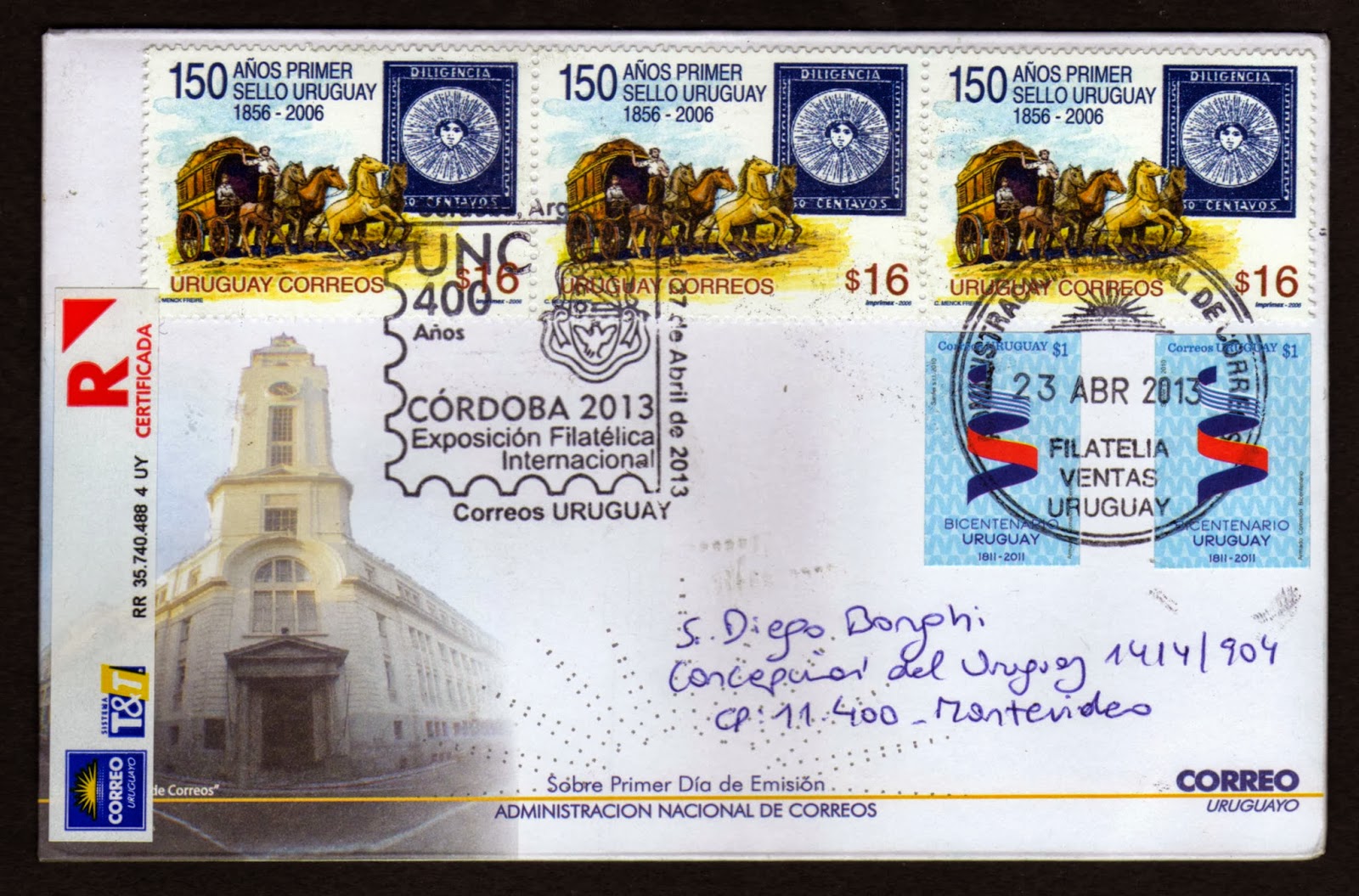
URU - 2013 - #014 - SPECIAL CANCELATION not Sent 1 - INTERNAT. PHILAT. EXHIBITION, CORDOBA 2013


Uruguay - 2013 - International Philatelic Exhibition, Cordoba 2013


Options:

FDC not Sent 1 --- 4,50 EUR
FDC not Sent 2 --- 4,50 EUR
FDC Sent on First Day 1 --- 9,00 EUR
FDC Sent on First Day 2 --- 9,00 EUR

If you are interested in any of this items, or any other items from Uruguay, just make a donation including your e-mail in the description.

I will contact you as soon I receive your donation, we agree on which items do you need, and I will discount the donation done to the amount of your purchase.


Issue information:

Country: Uruguay
Date: April 23rd, 2013

FDC Type: Normal
FDC Shape and Size: Rectangular [165 mm. x 105 mm.]

Topics:

Issue:

This special cancelation was released to promote the Internationa Philatelic Exhibition that took place in Córdoba, a city of Argentina, in year 2013, more precisely, from the day the cancelation was released, April 23rd, to the end of this week, April 27th, and was called "Córdoba 2013", and also named "400 Años de la Universidad Nacional de Córdoba 2013", in english: "400 Years of the National University of Córdoba". For this second name, the cancelation also takes the opportunity to celebrate the four centenary of this University.

The design of the cancelation it is composed, by the Coat of Arms of the Cordoba University, and some legends inside and outside a frame with two of his four sides resembles the perforation of a stamp, and the other two are single lines.

The legends inside the frame remark the exhibtion with: "CORDOBA 2013, Exposición Filatélica Internacional", in english: "CORDOBA 2013, International Philatelic Exhibition", and the university four centenary showing the legend: "UNC 400 años", that are the initials in spanish of the university, and its years of live being celebrated.

Then, outside the frame, the legend: "Córdoba, Argentina del 23 al 27 de Abril de 2013", locates the stamp exhibition in space and time, and is also acompanied by the legend for all official post office cancelations that says: "Correos URUGUAY".

Finally, a few more things about the desing, in particular, about the coat of arms of the university. First, as the University was built by the Jesuits, although not seen correctly in the cancelation, in the top of the oval are the letters "IHS" with a cross over the 'H' that identifies them, and it is the abbreviation of "JESUS HOMINUM SALVATOR".

Above this letters, and divided bya diagonal stripe showing the motto of the University in latin: "Ut portet nomen meum", that in english means: "In order to carry my name", there is a representation of the sun by two squares overlapped.

The last remarkable item in the coat of arms is the crowned eagle, with his wings wide open and in the motion of starting a flight. Icon that occupies the bottom half of the coat of arms central oval.

For the creation of the covers in which this special cancelations will be applied, two releases were selected. The stamps were chosen just by it relation to philatelic issues, being the first, the most related to the cancelation, as it is one commemorating another stamp exhibition, this one placed in Uruguay on year 2005 and called "Urutem 2005", then, the second stamp, is one from year 2006, and it celebrates, the 150 years of the first uruguyan stamp, stamp known as "Diligencia", in english: "Stagecoach", because it was used for postage carried by this conveyance, and this is the reason why, not only that old and valuable stamp is shown in the 2006 stamp, also a stagecoach, like the ones it carried them, is shown too.

As both stamps chosen have a facial value of 16 Uruguayan Pesos (UYP), and at the time of cover creation the minimum postage value is 15 UYP, to match the rule that for the application of the cancelation at least this amount should be included, only one stamp was used in both non sent FDCs. Then, for the cirulated ones, as the certified local postage at the time of the cover creation was 50 UYP, am horizontal stripe of three stamps, accompanied by two copies of the neutral uruguayan bicentennial stamp of 1 UYP, were elected to reach the exact postage value in the cover.

The realization of International Philatelic Exhibition called "400 Years of the National University of Córdoba 2013" is done in commemoration of the four centuries of life that meets the University of Cordoba in June this year.

As part of the celebrations, the "Centro Filatélico Mediterráneo (CEFIMED)", in english: "Mediterranean Philatelic Center" and "Centro Filatélico Córdoba (CEFICO)", in english "Cordoba Philatlic Center", both Philatelic Institutions from Cordoba, jointly organized from 23 to 27 April 2013, at the Argentina Pavilion of the City University of Cordoba, this international event that has the Sponsorship of the "Federación Argentina de Entidades Filatélicas (FAEF)", in english: "Federation of Argentinean Philatelic Institutions" and manages the Auspices of the "Federación Interamericana de Filatelia (FIAF)", in english: "American Federation of Philately". It also has the support of "Correo Argentino SA", the argentinean post office, and the National University of Cordoba.

The event was attended by Argentine collectors and representatives of Uruguay, Brazil, Paraguay, Bolivia and Chile, who competed and were evaluated by qualified judges.

They competed in ten categories (Traditional Philately, Postal History, Aerophilately and Astrophilately, postal stationery, Thematic Philately, Maximaphily Fiscal Framework Class A, Class Youth Philatelic Literature) by 8 medals (Large Gold Medal, Gold Medal, Medal Large Vermeil, Vermeil Medal, Large Silver Medal, Silver Medal, Bronze Medal Silver Medal Bronze).

In this context, Argentine Post Office presented at the opening ceremony, the Commemorative Stamp 400 years of the National University of Cordoba.

This exhibition was an opportunity for evaluating different mail pieces worldwide.

The "Universidad Nacional de Córdoba (UNC)", in english: "National University of Córdoba", is the oldest university in Argentina, the fourth oldest in South America and the sixth oldest in Latin America. It is located in Córdoba, the capital of Córdoba Province. Since the early 20th century it has been the second largest university in the country, after the University of Buenos Aires, in terms of the number of students, faculty, and academic programs. As the city location of the first university founded in the land that is now Argentina, Córdoba has earned the nickname: "La Docta", that in english means: "The Erudite".

Financially depends on the national government, but like all National Universities is autonomous. This autonomy implies that it has the power to manage their budget, choose their authorities and dictate its own standards according to the national level. While admission is unrestricted in most of careers must necessarily approve grading cycle. In a medical career for his part, there is a qualifying entrance exam.

It dates back to 1610 when the Jesuits established the Collegium Maximum (Maximum School), which was the basis for , on 1613, were initiated the higher studies though without authority to grant undergraduate degrees. On August 8, 1621 by Pope Gregory XV, by Apostolic Brief, High School gave the power to confer the degrees, which was ratified by Philip IV through the royal decree of February 2, 1622. This document came to Cordoba to the middle of that year. Pedro de Oñate, Provincial of the Society of Jesus, with the consent of the professors, declared the University open. Subsequently Pedro de Oñate drafted the regulations that were official valid. With the birth of the colloquially known as "Casa de Trejo", born the history of higher education in Argentina.

In 1820 General Juan Bautista Bustos, Governor of the Province of Córdoba , placed the University in the provincial orbit and finally in 1856 is nationalized. According to the research done by historian Lewis Pyanson at mid eighteenth century, it was established that the level of training in physics and mathematics at UNC, was the same as that of American universities in 1850.

In 1918 it was the setting for University Reform movement spreading throughout the continent.

The UNC, since its inception, had profound changes in all aspects. Of the 250,000 degrees awarded until 2010, 2,278 were delivered between 1613 and 1810, growing slowly until the mid-twentieth century when it grows exponentially now reaching about 7,000 students being graduated per year.

During its first two centuries of life, offered three higher learning: philosophy, theology and then law. After the Argentine civil wars, and organized institutionally Argentina, were being added Medicine and several hard sciences. Until 1884 there were no women egress. From that year the participation was gaining weight to be today half of all teachers and a large majority among students.

The National University of Cordoba has a student population of more than 110,000 students distributed in 13 colleges offering more than 250 undergraduate , graduate and doctoral degrees. The offer also includes 100 academic research and service centers , 25 libraries and 16 museums.

In 1610 the Society of Jesus founded the Collegium Maximum in Córdoba, which was attended by students of the order. An institution of the highest intellectual caliber for the time, this was the precursor of the university. While still under the control of the Jesuits, and during the administration of the Bishop of Tucumán, Juan Fernando de Trejo y Sanabria, advanced studies began to be offered at what was now known as the Colegio Maximo de Córdoba. The school did not yet have authority to confer degrees. This milestone would be soon reached; on August 8, 1621 Pope Gregory XV granted this authority by an official document, which arrived in the city in April 1622. With this authorization, and with the approval of the church hierarchy and the provincial head of the Jesuits, Pedro de Oñate, the university began its official existence. This also marks the beginning of the history of higher education in Argentina.

The Jesuits remained in control of the university until 1767, when they were expelled by order of King Carlos III. Leadership then passed to the Franciscan order. For the first 150 years after its founding, the university maintained an exclusive focus on philosophy and theology. The first secondary school in Cordoba was Our Lady of Monserrat, founded by a Jesuit priest, Father Ignacio Duarte y Quirós, in 1687 and incorporated into the university's aegis in 1907. The College of Montesrrat, as well as the original physical plant of the university and the Jesuit church, are part of the Jesuit Block, and were declared a World Heritage Site by UNESCO in 2000.

At the end of the 18th century, law studies were added (with the creation of the School of Law and Social Sciences), and from this time forward studies at the university were no longer exclusively theological. Following a conflict between the Franciscans and the secular clergy over the direction of the university, the house of study was renamed (by royal decree) to Royal University of Saint Charles and Our Lady of Monserrat. With this new name the university acquired the double title of Royal and Pontifical, and Monsignor Gregorio Funes was appointed president. With these changes, the Franciscans were replaced by the secular clergy as leaders of the university.

Monsignor Funes was the architect of profound reforms in studies and introduced new subjects. On May 25, 1810 the May Revolution began, and the new regime took control of the University of Córdoba, although Monsignor Funes remained in his post. In 1820 the university was relocated in other parts of the province of Córdoba, due to a situation of disorganization and chaos across the nation. Around the middle of the 19th century, a new national constitution was ratified, which outlined the new framework for the political organization of Argentina. At this time there were two provincial universities in the country: one in Córdoba and one in Buenos Aires (founded in 1821). The former was nationalized in 1856, the latter in 1881, leaving both under control of the national government.

Between 1860 and 1880, many academic reforms were instituted, similar to those occurring at other universities around the world. In 1864 theological studies were finally eliminated. During the presidency of Faustino Sarmiento the sciences gained momentum through the recruitment of foreign lecturers specializing in Mathematical-Physical Science, leading to the opening of the School of Exact, Physical, and Natural Sciences. This period also saw the birth of the Academy of Exact Sciences and the Astronomical Observatory. In 1877 the School of Medicine was opened. In 1885 the Law of Avellaneda, the first law pertaining to universities, was passed, laying out the ways in which the bylaws of the national universities could be amended, and their administrative framework, leaving other matters under the control of the universities themselves. In 1886 the bylaws of the university in Córdoba were modified to conform to the new law.

In June 1918 the student body at the university of Córdoba launched a movement, to which others all around the continent soon lent their voices, to fight for genuine democratization of the nation's academic activities. Hitherto controlled by interests related to the Catholic Church and the conservative lawmakers tied to the landed gentry, universities in Argentina gained unprecedented autonomy following these reforms.

In May 1969 a series of socio-economic events, closely connected to the French May (which had occurred exactly one year earlier), and with participation by students of the university as well as by workers of the middle and lower classes, led to changes in the educational and political strategies of the university. During the 20th century a number of new schools were created within the university, most of which began as institutes or departments within existing schools: the School of Philosophy and the Humanities, the School of Economics, the School of Architecture and Urban Studies (with Design added later), the School of Dentistry, the School of Chemistry, the School of Agriculture, and the School of Mathematics, Astronomy and Physics. Also created were the College of Languages (which later became a School) and the Manuel Belgrano College of Business.

In 2005 tensions erupted among the teaching staff, involving forceful tactics such as strikes and large-scale demonstrations in the city streets by students, faculty and citizens unaffiliated with the university, as demands were made for fairer pay and the cost of living increases required by law. As the year progressed some agreements were reached but the situation remains unresolved and protests continue.

At the University Assembly which took place on December 16, 2006 Dr. Carolina Scotto was elected president for the period of 2007 through 2010, becoming the first woman chosen to direct this institution. She was inaugurated on April 25, 2007.

The "Manzana Jesuítica y Estancias de Córdoba", in english: "Jesuit Block and Estancias of Córdoba" are a former Jesuit reduction built by missionaries in the province of Córdoba, Argentina, named a World Heritage Site in 2000.

The Manzana Jesuítica contains the University of Córdoba, one of the oldest in South America, the Monserrat Secondary School, a church, and residence buildings. To maintain such a project, the Jesuits operated six Estancias (residences) around the province of Córdoba, named Caroya, Jesús María, Santa Catalina, Alta Gracia, Candelaria and San Ignacio.

The farm and the complex, started in 1615, had to be left by the Jesuits, following the 1767 decree by King Charles III of Spain that expelled them from the continent. They were then run by the Franciscans until 1853, when the Jesuits returned to The Americas. Nevertheless, the university and the high-school were nationalized a year later.

Each Estancia has its own church and set of buildings, around which towns grew, such as Alta Gracia, the closest to the Block. The Estancia San Ignacio no longer exists. The Jesuit Block and the Estancias can be visited by tourists; the Road of the Jesuit Estancias has around 250 kilometres of length.

Jorge Mario Bergoglio, who would later become pope Francis lived there.

A UNESCO World Heritage Site is a place (such as a forest, mountain, lake, island, desert, monument, building, complex, or city) that is listed by the UNESCO as of special cultural or physical significance. The list is maintained by the international World Heritage Programme administered by the UNESCO World Heritage Committee, composed of 21 states' parties which are elected by their General Assembly.

The programme catalogues, names, and conserves sites of outstanding cultural or natural importance to the common heritage of humanity. Under certain conditions, listed sites can obtain funds from the World Heritage Fund. The programme was founded with the Convention Concerning the Protection of the World Cultural and Natural Heritage, which was adopted by the General Conference of UNESCO on 16 November 1972. Since then, 190 states parties have ratified the Convention, making it one of the most adhered to international instruments. Only the Bahamas, Liechtenstein, Nauru, Somalia, South Sudan, Timor-Leste and Tuvalu are not Party to the Convention.

As of 2013, 981 sites are listed: 759 cultural, 193 natural, and 29 mixed properties, in 160 states parties. By sites ranked by country, Italy is home to the greatest number of World Heritage Sites with 49 sites, followed by China (45) and Spain (44). UNESCO references each World Heritage Site with an identification number; but new inscriptions often include previous sites now listed as part of larger descriptions. As a result, the identification numbers exceed 1,200 even though there are fewer on the list.

While each World Heritage Site remains part of the legal territory of the state wherein the site is located, UNESCO considers it in the interest of the international community to preserve each site.

Córdoba is a city located in the geographical center of Argentina, in the foothills of the "Sierras Chicas" on the "Suquía" River, about 700 km (435 mi) northwest of "Buenos Aires", capital of Argentina. It is the capital of Córdoba Province and the second-largest city in Argentina after the autonomous city of Buenos Aires, with about 1.3 million inhabitants according to the 2001 census.

It was founded on 6 July 1573 by Jerónimo Luis de Cabrera, who named it after Córdoba, Spain. It was one of the first Spanish colonial capitals of the region that is now Argentina (the oldest city is Santiago del Estero, founded in 1553). The National University of Córdoba is the oldest university of the country and the fourth to be inaugurated in Latin America. It was founded in 1613 by the Jesuit Order. Because of this, Córdoba earned the nickname "La Docta", in english: "The erudite".

Córdoba has many historical monuments preserved from Spanish colonial rule, especially buildings of the Roman Catholic Church. The most recognizable is perhaps the Jesuit Block (Spanish: Manzana Jesuítica), declared in 2000 as a World Heritage Site by UNESCO which consists of a group of buildings dating from the 17th century, including the Colegio Nacional de Monserrat and the colonial university campus. The campus belongs today to the historical museum of the National University of Córdoba, which has been the second-largest university in the country since the early 20th century (after the University of Buenos Aires), in terms of the number of students, faculty, and academic programs. Córdoba is also known for its historical movements, such as Cordobazo and La Reforma del '18 (known as University Revolution in English).

The Society of Jesus (Latin: Societas Iesu, S.J., SJ or SI) is a Christian male religious order of the Roman Catholic Church. The members are called Jesuits. The society is engaged in evangelization and apostolic ministry in 112 nations on six continents. Jesuits work in education (founding schools, colleges, universities and seminaries), intellectual research, and cultural pursuits. Jesuits also give retreats, minister in hospitals and parishes and promote social justice and ecumenical dialogue.

Ignatius of Loyola founded the society after being wounded in battle and experiencing a religious conversion. He composed the Spiritual Exercises to help others follow the teachings of Jesus Christ. In 1534, Ignatius and six other young men, including Francis Xavier and Bl. Peter Faber, gathered and professed vows of poverty, chastity, and later obedience, including a special vow of obedience to the Pope. Rule 13 of Ignatius's Rules for Thinking with the Church said: "That we may be altogether of the same mind and in conformity [...], if [the Church] shall have defined anything to be black which to our eyes appears to be white, we ought in like manner to pronounce it to be black." Ignatius's plan of the order's organization was approved by Pope Paul III in 1540 by the bull containing the "Formula of the Institute".

Because of the military background of Ignatius and the members' willingness to accept orders anywhere in the world and to live in extreme conditions where required, the opening lines of this founding document would declare that the Society of Jesus was founded for "whoever desires to serve as a soldier of God" (Spanish: "todo el que quiera militar para Dios"), "to strive especially for the defense and propagation of the faith and for the progress of souls in Christian life and doctrine." Therefore Jesuits are sometimes referred to colloquially as "God's Soldiers" or "God's Marines". The Society participated in the Counter-Reformation and later in the implementation of the Second Vatican Council in the Catholic Church.

The Society of Jesus is consecrated under the patronage of Madonna Della Strada, a title of the Blessed Virgin Mary, and it is led by a Superior General, currently Adolfo Nicolás.

The headquarters of the society, its General Curia, is in Rome. The historic curia of St. Ignatius is now part of the Collegio del Gesù attached to the Church of the Gesù, the Jesuit Mother Church.

A Coat of arms is a unique heraldic design on an escutcheon (i.e. shield), surcoat, or tabard. A surcoat, and subsequently a coat of arms was used by medieval knights to cover, protect, and identify the wearer. Thus these are sometimes termed coat armory. The coat of arms on an escutcheon forms the central element of the full heraldic achievement which consists of shield, supporters, crest, and motto. The design is a symbol unique to an individual person or family (except in the UK), corporation, or state. Such displays are commonly called armorial bearings, armorial devices, heraldic devices, or simply arms.

The ancient Romans used similar insignias similar on their shields, but these identified military units rather than individuals. The first evidence of medieval coats of arms is found in the Bayeux Tapestry from the 11th Century, where some of the combatants carry shields painted with crosses. Coats of arms came into general use by feudal lords and knights in battle in the 12th Century. By the 13th Century arms had spread beyond their initial battlefield use to become a kind of flag or logo for families in the higher social classes of Europe, inherited from one generation to the next. Exactly who had a right to use arms, by law or social convention, varied to some degree between countries. In the German-speaking region both the aristocracy and burghers (non-noble free citizens) used arms, while in most of the rest of Europe they were limited to the aristocracy. The use of arms spread to Church clergy, and to towns as civic identifiers, and to royally-chartered organizations such as universities and trading companies. Flags developed from coats of arms, and the arts of vexillology and heraldry are closely related. The coats of arms granted to commercial companies are a major source of the modern logo.

Despite no widespread regulation, and even with a lack in many cases of national regulation, heraldry has remained rather consistent across Europe, where traditions alone have governed the design and use of arms. Unlike seals and other general emblems, heraldic achievements have a formal description called a blazon, expressed in a jargon that allows for consistency in heraldic depictions.

n the 21st century, coats of arms are still in use by a variety of institutions and individuals; for example, many European cities and universities have guidelines on how their coats of arms may be used, and protect their use as trademarks. Many societies exist that also aid in the design and registration of personal arms. Some nations, like England and Scotland, still maintain the same heraldic authorities which have traditionally granted and regulated arms for centuries and continue to do so in the present day.

Eagle is a common name for some members of the bird family Accipitridae; it belongs to several genera that are not necessarily closely related to each other. Most of the more than sixty species of eagles occur in Eurasia and Africa. Outside this area, just eleven species can be found – two species (the Bald Eagle and Golden Eagle) in the United States and Canada, nine species in Central America and South America, and three species in Australia.

Eagles are large, powerfully built birds of prey, with a heavy head and beak. Even the smallest eagles, like the Booted Eagle (Aquila pennata) (which is comparable in size to a Common Buzzard (Buteo buteo) or Red-tailed Hawk (B. jamaicensis)), have relatively longer and more evenly broad wings, and more direct, faster flight – despite the reduced size of aerodynamic feathers. Most eagles are larger than any other raptors apart from some vultures. The smallest species of eagle is the South Nicobar Serpent Eagle (Spilornis klossi), at 450 g (1 lb) and 40 cm (16 in). The largest species are discussed below. Like all birds of prey, eagles have very large hooked beaks for tearing flesh from their prey, strong muscular legs, and powerful talons. The beak is typically heavier than that of most other birds of prey. Eagles' eyes are extremely powerful, having up to 3.6 times human acuity for the martial eagle, which enables them to spot potential prey from a very long distance. This keen eyesight is primarily attributed to their extremely large pupils which ensure minimal diffraction (scattering) of the incoming light. The female of all species of eagle known is larger than the male.

Eagles normally build their nests, called eyries, in tall trees or on high cliffs. Many species lay two eggs, but the older, larger chick frequently kills its younger sibling once it has hatched. The dominant chick tends to be the female, as they are bigger than the male. The parents take no action to stop the killing.

Due to the size and power of many eagle species, they are ranked at the top of the food chain as apex predators in the avian world. The type of prey varies from genus to genus. The Haliaeetus and Ichthyophaga eagles prefer to capture fish, though the species in the former often capture various animals, especially other water birds, and are powerful kleptoparasites of other birds. The snake and serpent eagles of the genera Circaetus, Terathopius and Spilornis predominantly prey on the great diversity of snakes that are found in the tropics of Africa and Asia. The eagles of the genus Aquila are often the top birds of prey in open habitats, taking almost any medium-sized vertebrate they can catch. Where Aquila eagles are absent, other eagles, such as the buteonine Black-chested Buzzard-Eagle of South America, may assume the position of top raptorial predator in open areas. Many other eagles, including the species-rich Spizaetus genus, live predominantly in woodlands and forest. These eagles often target various arboreal or ground-dwelling mammals and birds, which are often unsuspectingly ambushed in such dense, knotty environments. Hunting techniques differ among the species and genera, with some individual eagles having engaged in quite varied techniques based their environment and prey at any given time. Most eagles grab prey without landing and take flight with it so the prey can be carried to a perch and torn apart. The Bald Eagle is noted for having flown with the heaviest load verified to be carried by any flying bird, since one eagle flew with a 6.8 kg (15 lb) mule deer fawn. However, a few eagles may target prey considerably heavier than themselves; such prey is too heavy to fly with and thus it is either eaten at the site of the kill or taken in pieces back to a perch or nest. Golden and Crowned Eagles have killed ungulates weighing up to 30 kg (66 lb) and a Martial Eagle even killed a 37 kg (82 lb) duiker, 7–8 times heavier than the predating eagle. Authors on birds David Allen Sibley, Pete Dunne and Clay Sutton, described the behavioral difference between hunting eagles and other birds of prey thus (in this case the Bald and Golden Eagles as compared to other North American raptors):

They have at least one singular characteristic. It has been observed that most birds of prey look back over their shoulders before striking prey (or shortly thereafter); predation is after all a two-edged sword. All hawks seem to have this habit, from the smallest kestrel to the largest Ferruginous – but not the Eagles.

Among the eagles are some of the largest birds of prey: only the condors and some of the Old World vultures are markedly larger. It is regularly debated which should be considered the largest species of eagle. They could be measured variously in total length, body mass or wingspan. Different lifestyle needs among various eagles result in variable measurements from species to species. For example, many forest-dwelling eagles, including the very large Harpy and Philippine Eagles, have relatively short wingspans, a feature necessary for being able to maneuver in quick, short bursts through dense forested habitats. On the other hand, eagles in the genus Aquila are found almost strictly in open country, are superlative soarers, and have relatively long wings for their size.

The modern English term for the bird is derived from Latin: aquila by way of French: aigle. The origin of aquila is unknown, but it is believed to possibly derive from either aquilus (meaning dark-colored, swarthy, or blackish) as a reference to the plumage of eagles or from aquilo (meaning north wind).

Old English used the term earn, related to Scandinavia's ørn / örn. It is similar to other Indo-European terms for "bird" or "eagle", including Greek: ὄρνις (ornís), Russian: орёл (orël), and Welsh: eryr. The Albanian word for eagle is shqiponjë, deriving from the root shqipe.

In Britain before 1678, eagle referred specifically to the Golden Eagle, with the other native species, the White-tailed Eagle, being known as erne. The modern name "Golden Eagle" for aquila chrysaetos was introduced by naturalist John Ray.

The Moche people of ancient Peru worshiped the animal and often depicted eagles in their art.

In Hindu religion, Garuda is a lesser Hindu divinity, usually the mount (vahanam) of Vishnu. Garuda is depicted as having the golden body of a strong man with a white face, red wings, and an eagle's beak and with a crown on his head. This ancient deity was said to be massive, large enough to block out the sun.

The eagle is also the patron animal of Zeus. In particular, Zeus was said to have taken the form of an eagle in order to abduct Ganymede, and there are numerous artistic depictions of the Eagle Zeus bearing Ganymede aloft, from Classical times up to the present.

Eagles have been used by many nations as a national symbol.


If you consider that there are another topics in this stamp, that were not spot in this review, you are encouraged to telling me about them, so please do not hesitate to post a comment. I would appreciate your help very much.

URU - 2013 - #014 - SPECIAL CANCELATION Sent on First Day 2 - INTERNAT. PHILAT. EXHIBITION, CORDOBA 2013


Uruguay - 2013 - International Philatelic Exhibition, Cordoba 2013


If you are interested in any of this items, or any other items from Uruguay, just make a donation including your e-mail in the description.

I will contact you as soon I receive your donation, we agree on which items do you need, and I will discount the donation done to the amount of your purchase.


URU - 2013 - #014 - SPECIAL CANCELATION Sent on First Day 1 - INTERNAT. PHILAT. EXHIBITION, CORDOBA 2013


Uruguay - 2013 - International Philatelic Exhibition, Cordoba 2013


If you are interested in any of this items, or any other items from Uruguay, just make a donation including your e-mail in the description.

I will contact you as soon I receive your donation, we agree on which items do you need, and I will discount the donation done to the amount of your purchase.


URU - 2013 - #014 - SPECIAL CANCELATION not Sent 2 - INTERNAT. PHILAT. EXHIBITION, CORDOBA 2013


Uruguay - 2013 - International Philatelic Exhibition, Cordoba 2013


If you are interested in any of this items, or any other items from Uruguay, just make a donation including your e-mail in the description.

I will contact you as soon I receive your donation, we agree on which items do you need, and I will discount the donation done to the amount of your purchase.


URU - 2013 - #014 - SPECIAL CANCELATION not Sent 1 - INTERNAT. PHILAT. EXHIBITION, CORDOBA 2013


Uruguay - 2013 - International Philatelic Exhibition, Cordoba 2013


Options:

FDC not Sent 1 --- 4,50 EUR
FDC not Sent 2 --- 4,50 EUR
FDC Sent on First Day 1 --- 9,00 EUR
FDC Sent on First Day 2 --- 9,00 EUR

If you are interested in any of this items, or any other items from Uruguay, just make a donation including your e-mail in the description.

I will contact you as soon I receive your donation, we agree on which items do you need, and I will discount the donation done to the amount of your purchase.


Issue information:

Country: Uruguay
Date: April 23rd, 2013

FDC Type: Normal
FDC Shape and Size: Rectangular [165 mm. x 105 mm.]

Topics:

Issue:

This special cancelation was released to promote the Internationa Philatelic Exhibition that took place in Córdoba, a city of Argentina, in year 2013, more precisely, from the day the cancelation was released, April 23rd, to the end of this week, April 27th, and was called "Córdoba 2013", and also named "400 Años de la Universidad Nacional de Córdoba 2013", in english: "400 Years of the National University of Córdoba". For this second name, the cancelation also takes the opportunity to celebrate the four centenary of this University.

The design of the cancelation it is composed, by the Coat of Arms of the Cordoba University, and some legends inside and outside a frame with two of his four sides resembles the perforation of a stamp, and the other two are single lines.

The legends inside the frame remark the exhibtion with: "CORDOBA 2013, Exposición Filatélica Internacional", in english: "CORDOBA 2013, International Philatelic Exhibition", and the university four centenary showing the legend: "UNC 400 años", that are the initials in spanish of the university, and its years of live being celebrated.

Then, outside the frame, the legend: "Córdoba, Argentina del 23 al 27 de Abril de 2013", locates the stamp exhibition in space and time, and is also acompanied by the legend for all official post office cancelations that says: "Correos URUGUAY".

Finally, a few more things about the desing, in particular, about the coat of arms of the university. First, as the University was built by the Jesuits, although not seen correctly in the cancelation, in the top of the oval are the letters "IHS" with a cross over the 'H' that identifies them, and it is the abbreviation of "JESUS HOMINUM SALVATOR".

Above this letters, and divided bya diagonal stripe showing the motto of the University in latin: "Ut portet nomen meum", that in english means: "In order to carry my name", there is a representation of the sun by two squares overlapped.

The last remarkable item in the coat of arms is the crowned eagle, with his wings wide open and in the motion of starting a flight. Icon that occupies the bottom half of the coat of arms central oval.

For the creation of the covers in which this special cancelations will be applied, two releases were selected. The stamps were chosen just by it relation to philatelic issues, being the first, the most related to the cancelation, as it is one commemorating another stamp exhibition, this one placed in Uruguay on year 2005 and called "Urutem 2005", then, the second stamp, is one from year 2006, and it celebrates, the 150 years of the first uruguyan stamp, stamp known as "Diligencia", in english: "Stagecoach", because it was used for postage carried by this conveyance, and this is the reason why, not only that old and valuable stamp is shown in the 2006 stamp, also a stagecoach, like the ones it carried them, is shown too.

As both stamps chosen have a facial value of 16 Uruguayan Pesos (UYP), and at the time of cover creation the minimum postage value is 15 UYP, to match the rule that for the application of the cancelation at least this amount should be included, only one stamp was used in both non sent FDCs. Then, for the cirulated ones, as the certified local postage at the time of the cover creation was 50 UYP, am horizontal stripe of three stamps, accompanied by two copies of the neutral uruguayan bicentennial stamp of 1 UYP, were elected to reach the exact postage value in the cover.

The realization of International Philatelic Exhibition called "400 Years of the National University of Córdoba 2013" is done in commemoration of the four centuries of life that meets the University of Cordoba in June this year.

As part of the celebrations, the "Centro Filatélico Mediterráneo (CEFIMED)", in english: "Mediterranean Philatelic Center" and "Centro Filatélico Córdoba (CEFICO)", in english "Cordoba Philatlic Center", both Philatelic Institutions from Cordoba, jointly organized from 23 to 27 April 2013, at the Argentina Pavilion of the City University of Cordoba, this international event that has the Sponsorship of the "Federación Argentina de Entidades Filatélicas (FAEF)", in english: "Federation of Argentinean Philatelic Institutions" and manages the Auspices of the "Federación Interamericana de Filatelia (FIAF)", in english: "American Federation of Philately". It also has the support of "Correo Argentino SA", the argentinean post office, and the National University of Cordoba.

The event was attended by Argentine collectors and representatives of Uruguay, Brazil, Paraguay, Bolivia and Chile, who competed and were evaluated by qualified judges.

They competed in ten categories (Traditional Philately, Postal History, Aerophilately and Astrophilately, postal stationery, Thematic Philately, Maximaphily Fiscal Framework Class A, Class Youth Philatelic Literature) by 8 medals (Large Gold Medal, Gold Medal, Medal Large Vermeil, Vermeil Medal, Large Silver Medal, Silver Medal, Bronze Medal Silver Medal Bronze).

In this context, Argentine Post Office presented at the opening ceremony, the Commemorative Stamp 400 years of the National University of Cordoba.

This exhibition was an opportunity for evaluating different mail pieces worldwide.

The "Universidad Nacional de Córdoba (UNC)", in english: "National University of Córdoba", is the oldest university in Argentina, the fourth oldest in South America and the sixth oldest in Latin America. It is located in Córdoba, the capital of Córdoba Province. Since the early 20th century it has been the second largest university in the country, after the University of Buenos Aires, in terms of the number of students, faculty, and academic programs. As the city location of the first university founded in the land that is now Argentina, Córdoba has earned the nickname: "La Docta", that in english means: "The Erudite".

Financially depends on the national government, but like all National Universities is autonomous. This autonomy implies that it has the power to manage their budget, choose their authorities and dictate its own standards according to the national level. While admission is unrestricted in most of careers must necessarily approve grading cycle. In a medical career for his part, there is a qualifying entrance exam.

It dates back to 1610 when the Jesuits established the Collegium Maximum (Maximum School), which was the basis for , on 1613, were initiated the higher studies though without authority to grant undergraduate degrees. On August 8, 1621 by Pope Gregory XV, by Apostolic Brief, High School gave the power to confer the degrees, which was ratified by Philip IV through the royal decree of February 2, 1622. This document came to Cordoba to the middle of that year. Pedro de Oñate, Provincial of the Society of Jesus, with the consent of the professors, declared the University open. Subsequently Pedro de Oñate drafted the regulations that were official valid. With the birth of the colloquially known as "Casa de Trejo", born the history of higher education in Argentina.

In 1820 General Juan Bautista Bustos, Governor of the Province of Córdoba , placed the University in the provincial orbit and finally in 1856 is nationalized. According to the research done by historian Lewis Pyanson at mid eighteenth century, it was established that the level of training in physics and mathematics at UNC, was the same as that of American universities in 1850.

In 1918 it was the setting for University Reform movement spreading throughout the continent.

The UNC, since its inception, had profound changes in all aspects. Of the 250,000 degrees awarded until 2010, 2,278 were delivered between 1613 and 1810, growing slowly until the mid-twentieth century when it grows exponentially now reaching about 7,000 students being graduated per year.

During its first two centuries of life, offered three higher learning: philosophy, theology and then law. After the Argentine civil wars, and organized institutionally Argentina, were being added Medicine and several hard sciences. Until 1884 there were no women egress. From that year the participation was gaining weight to be today half of all teachers and a large majority among students.

The National University of Cordoba has a student population of more than 110,000 students distributed in 13 colleges offering more than 250 undergraduate , graduate and doctoral degrees. The offer also includes 100 academic research and service centers , 25 libraries and 16 museums.

In 1610 the Society of Jesus founded the Collegium Maximum in Córdoba, which was attended by students of the order. An institution of the highest intellectual caliber for the time, this was the precursor of the university. While still under the control of the Jesuits, and during the administration of the Bishop of Tucumán, Juan Fernando de Trejo y Sanabria, advanced studies began to be offered at what was now known as the Colegio Maximo de Córdoba. The school did not yet have authority to confer degrees. This milestone would be soon reached; on August 8, 1621 Pope Gregory XV granted this authority by an official document, which arrived in the city in April 1622. With this authorization, and with the approval of the church hierarchy and the provincial head of the Jesuits, Pedro de Oñate, the university began its official existence. This also marks the beginning of the history of higher education in Argentina.

The Jesuits remained in control of the university until 1767, when they were expelled by order of King Carlos III. Leadership then passed to the Franciscan order. For the first 150 years after its founding, the university maintained an exclusive focus on philosophy and theology. The first secondary school in Cordoba was Our Lady of Monserrat, founded by a Jesuit priest, Father Ignacio Duarte y Quirós, in 1687 and incorporated into the university's aegis in 1907. The College of Montesrrat, as well as the original physical plant of the university and the Jesuit church, are part of the Jesuit Block, and were declared a World Heritage Site by UNESCO in 2000.

At the end of the 18th century, law studies were added (with the creation of the School of Law and Social Sciences), and from this time forward studies at the university were no longer exclusively theological. Following a conflict between the Franciscans and the secular clergy over the direction of the university, the house of study was renamed (by royal decree) to Royal University of Saint Charles and Our Lady of Monserrat. With this new name the university acquired the double title of Royal and Pontifical, and Monsignor Gregorio Funes was appointed president. With these changes, the Franciscans were replaced by the secular clergy as leaders of the university.

Monsignor Funes was the architect of profound reforms in studies and introduced new subjects. On May 25, 1810 the May Revolution began, and the new regime took control of the University of Córdoba, although Monsignor Funes remained in his post. In 1820 the university was relocated in other parts of the province of Córdoba, due to a situation of disorganization and chaos across the nation. Around the middle of the 19th century, a new national constitution was ratified, which outlined the new framework for the political organization of Argentina. At this time there were two provincial universities in the country: one in Córdoba and one in Buenos Aires (founded in 1821). The former was nationalized in 1856, the latter in 1881, leaving both under control of the national government.

Between 1860 and 1880, many academic reforms were instituted, similar to those occurring at other universities around the world. In 1864 theological studies were finally eliminated. During the presidency of Faustino Sarmiento the sciences gained momentum through the recruitment of foreign lecturers specializing in Mathematical-Physical Science, leading to the opening of the School of Exact, Physical, and Natural Sciences. This period also saw the birth of the Academy of Exact Sciences and the Astronomical Observatory. In 1877 the School of Medicine was opened. In 1885 the Law of Avellaneda, the first law pertaining to universities, was passed, laying out the ways in which the bylaws of the national universities could be amended, and their administrative framework, leaving other matters under the control of the universities themselves. In 1886 the bylaws of the university in Córdoba were modified to conform to the new law.

In June 1918 the student body at the university of Córdoba launched a movement, to which others all around the continent soon lent their voices, to fight for genuine democratization of the nation's academic activities. Hitherto controlled by interests related to the Catholic Church and the conservative lawmakers tied to the landed gentry, universities in Argentina gained unprecedented autonomy following these reforms.

In May 1969 a series of socio-economic events, closely connected to the French May (which had occurred exactly one year earlier), and with participation by students of the university as well as by workers of the middle and lower classes, led to changes in the educational and political strategies of the university. During the 20th century a number of new schools were created within the university, most of which began as institutes or departments within existing schools: the School of Philosophy and the Humanities, the School of Economics, the School of Architecture and Urban Studies (with Design added later), the School of Dentistry, the School of Chemistry, the School of Agriculture, and the School of Mathematics, Astronomy and Physics. Also created were the College of Languages (which later became a School) and the Manuel Belgrano College of Business.

In 2005 tensions erupted among the teaching staff, involving forceful tactics such as strikes and large-scale demonstrations in the city streets by students, faculty and citizens unaffiliated with the university, as demands were made for fairer pay and the cost of living increases required by law. As the year progressed some agreements were reached but the situation remains unresolved and protests continue.

At the University Assembly which took place on December 16, 2006 Dr. Carolina Scotto was elected president for the period of 2007 through 2010, becoming the first woman chosen to direct this institution. She was inaugurated on April 25, 2007.

The "Manzana Jesuítica y Estancias de Córdoba", in english: "Jesuit Block and Estancias of Córdoba" are a former Jesuit reduction built by missionaries in the province of Córdoba, Argentina, named a World Heritage Site in 2000.

The Manzana Jesuítica contains the University of Córdoba, one of the oldest in South America, the Monserrat Secondary School, a church, and residence buildings. To maintain such a project, the Jesuits operated six Estancias (residences) around the province of Córdoba, named Caroya, Jesús María, Santa Catalina, Alta Gracia, Candelaria and San Ignacio.

The farm and the complex, started in 1615, had to be left by the Jesuits, following the 1767 decree by King Charles III of Spain that expelled them from the continent. They were then run by the Franciscans until 1853, when the Jesuits returned to The Americas. Nevertheless, the university and the high-school were nationalized a year later.

Each Estancia has its own church and set of buildings, around which towns grew, such as Alta Gracia, the closest to the Block. The Estancia San Ignacio no longer exists. The Jesuit Block and the Estancias can be visited by tourists; the Road of the Jesuit Estancias has around 250 kilometres of length.

Jorge Mario Bergoglio, who would later become pope Francis lived there.

A UNESCO World Heritage Site is a place (such as a forest, mountain, lake, island, desert, monument, building, complex, or city) that is listed by the UNESCO as of special cultural or physical significance. The list is maintained by the international World Heritage Programme administered by the UNESCO World Heritage Committee, composed of 21 states' parties which are elected by their General Assembly.

The programme catalogues, names, and conserves sites of outstanding cultural or natural importance to the common heritage of humanity. Under certain conditions, listed sites can obtain funds from the World Heritage Fund. The programme was founded with the Convention Concerning the Protection of the World Cultural and Natural Heritage, which was adopted by the General Conference of UNESCO on 16 November 1972. Since then, 190 states parties have ratified the Convention, making it one of the most adhered to international instruments. Only the Bahamas, Liechtenstein, Nauru, Somalia, South Sudan, Timor-Leste and Tuvalu are not Party to the Convention.

As of 2013, 981 sites are listed: 759 cultural, 193 natural, and 29 mixed properties, in 160 states parties. By sites ranked by country, Italy is home to the greatest number of World Heritage Sites with 49 sites, followed by China (45) and Spain (44). UNESCO references each World Heritage Site with an identification number; but new inscriptions often include previous sites now listed as part of larger descriptions. As a result, the identification numbers exceed 1,200 even though there are fewer on the list.

While each World Heritage Site remains part of the legal territory of the state wherein the site is located, UNESCO considers it in the interest of the international community to preserve each site.

Córdoba is a city located in the geographical center of Argentina, in the foothills of the "Sierras Chicas" on the "Suquía" River, about 700 km (435 mi) northwest of "Buenos Aires", capital of Argentina. It is the capital of Córdoba Province and the second-largest city in Argentina after the autonomous city of Buenos Aires, with about 1.3 million inhabitants according to the 2001 census.

It was founded on 6 July 1573 by Jerónimo Luis de Cabrera, who named it after Córdoba, Spain. It was one of the first Spanish colonial capitals of the region that is now Argentina (the oldest city is Santiago del Estero, founded in 1553). The National University of Córdoba is the oldest university of the country and the fourth to be inaugurated in Latin America. It was founded in 1613 by the Jesuit Order. Because of this, Córdoba earned the nickname "La Docta", in english: "The erudite".

Córdoba has many historical monuments preserved from Spanish colonial rule, especially buildings of the Roman Catholic Church. The most recognizable is perhaps the Jesuit Block (Spanish: Manzana Jesuítica), declared in 2000 as a World Heritage Site by UNESCO which consists of a group of buildings dating from the 17th century, including the Colegio Nacional de Monserrat and the colonial university campus. The campus belongs today to the historical museum of the National University of Córdoba, which has been the second-largest university in the country since the early 20th century (after the University of Buenos Aires), in terms of the number of students, faculty, and academic programs. Córdoba is also known for its historical movements, such as Cordobazo and La Reforma del '18 (known as University Revolution in English).

The Society of Jesus (Latin: Societas Iesu, S.J., SJ or SI) is a Christian male religious order of the Roman Catholic Church. The members are called Jesuits. The society is engaged in evangelization and apostolic ministry in 112 nations on six continents. Jesuits work in education (founding schools, colleges, universities and seminaries), intellectual research, and cultural pursuits. Jesuits also give retreats, minister in hospitals and parishes and promote social justice and ecumenical dialogue.

Ignatius of Loyola founded the society after being wounded in battle and experiencing a religious conversion. He composed the Spiritual Exercises to help others follow the teachings of Jesus Christ. In 1534, Ignatius and six other young men, including Francis Xavier and Bl. Peter Faber, gathered and professed vows of poverty, chastity, and later obedience, including a special vow of obedience to the Pope. Rule 13 of Ignatius's Rules for Thinking with the Church said: "That we may be altogether of the same mind and in conformity [...], if [the Church] shall have defined anything to be black which to our eyes appears to be white, we ought in like manner to pronounce it to be black." Ignatius's plan of the order's organization was approved by Pope Paul III in 1540 by the bull containing the "Formula of the Institute".

Because of the military background of Ignatius and the members' willingness to accept orders anywhere in the world and to live in extreme conditions where required, the opening lines of this founding document would declare that the Society of Jesus was founded for "whoever desires to serve as a soldier of God" (Spanish: "todo el que quiera militar para Dios"), "to strive especially for the defense and propagation of the faith and for the progress of souls in Christian life and doctrine." Therefore Jesuits are sometimes referred to colloquially as "God's Soldiers" or "God's Marines". The Society participated in the Counter-Reformation and later in the implementation of the Second Vatican Council in the Catholic Church.

The Society of Jesus is consecrated under the patronage of Madonna Della Strada, a title of the Blessed Virgin Mary, and it is led by a Superior General, currently Adolfo Nicolás.

The headquarters of the society, its General Curia, is in Rome. The historic curia of St. Ignatius is now part of the Collegio del Gesù attached to the Church of the Gesù, the Jesuit Mother Church.

A Coat of arms is a unique heraldic design on an escutcheon (i.e. shield), surcoat, or tabard. A surcoat, and subsequently a coat of arms was used by medieval knights to cover, protect, and identify the wearer. Thus these are sometimes termed coat armory. The coat of arms on an escutcheon forms the central element of the full heraldic achievement which consists of shield, supporters, crest, and motto. The design is a symbol unique to an individual person or family (except in the UK), corporation, or state. Such displays are commonly called armorial bearings, armorial devices, heraldic devices, or simply arms.

The ancient Romans used similar insignias similar on their shields, but these identified military units rather than individuals. The first evidence of medieval coats of arms is found in the Bayeux Tapestry from the 11th Century, where some of the combatants carry shields painted with crosses. Coats of arms came into general use by feudal lords and knights in battle in the 12th Century. By the 13th Century arms had spread beyond their initial battlefield use to become a kind of flag or logo for families in the higher social classes of Europe, inherited from one generation to the next. Exactly who had a right to use arms, by law or social convention, varied to some degree between countries. In the German-speaking region both the aristocracy and burghers (non-noble free citizens) used arms, while in most of the rest of Europe they were limited to the aristocracy. The use of arms spread to Church clergy, and to towns as civic identifiers, and to royally-chartered organizations such as universities and trading companies. Flags developed from coats of arms, and the arts of vexillology and heraldry are closely related. The coats of arms granted to commercial companies are a major source of the modern logo.

Despite no widespread regulation, and even with a lack in many cases of national regulation, heraldry has remained rather consistent across Europe, where traditions alone have governed the design and use of arms. Unlike seals and other general emblems, heraldic achievements have a formal description called a blazon, expressed in a jargon that allows for consistency in heraldic depictions.

n the 21st century, coats of arms are still in use by a variety of institutions and individuals; for example, many European cities and universities have guidelines on how their coats of arms may be used, and protect their use as trademarks. Many societies exist that also aid in the design and registration of personal arms. Some nations, like England and Scotland, still maintain the same heraldic authorities which have traditionally granted and regulated arms for centuries and continue to do so in the present day.

Eagle is a common name for some members of the bird family Accipitridae; it belongs to several genera that are not necessarily closely related to each other. Most of the more than sixty species of eagles occur in Eurasia and Africa. Outside this area, just eleven species can be found – two species (the Bald Eagle and Golden Eagle) in the United States and Canada, nine species in Central America and South America, and three species in Australia.

Eagles are large, powerfully built birds of prey, with a heavy head and beak. Even the smallest eagles, like the Booted Eagle (Aquila pennata) (which is comparable in size to a Common Buzzard (Buteo buteo) or Red-tailed Hawk (B. jamaicensis)), have relatively longer and more evenly broad wings, and more direct, faster flight – despite the reduced size of aerodynamic feathers. Most eagles are larger than any other raptors apart from some vultures. The smallest species of eagle is the South Nicobar Serpent Eagle (Spilornis klossi), at 450 g (1 lb) and 40 cm (16 in). The largest species are discussed below. Like all birds of prey, eagles have very large hooked beaks for tearing flesh from their prey, strong muscular legs, and powerful talons. The beak is typically heavier than that of most other birds of prey. Eagles' eyes are extremely powerful, having up to 3.6 times human acuity for the martial eagle, which enables them to spot potential prey from a very long distance. This keen eyesight is primarily attributed to their extremely large pupils which ensure minimal diffraction (scattering) of the incoming light. The female of all species of eagle known is larger than the male.

Eagles normally build their nests, called eyries, in tall trees or on high cliffs. Many species lay two eggs, but the older, larger chick frequently kills its younger sibling once it has hatched. The dominant chick tends to be the female, as they are bigger than the male. The parents take no action to stop the killing.

Due to the size and power of many eagle species, they are ranked at the top of the food chain as apex predators in the avian world. The type of prey varies from genus to genus. The Haliaeetus and Ichthyophaga eagles prefer to capture fish, though the species in the former often capture various animals, especially other water birds, and are powerful kleptoparasites of other birds. The snake and serpent eagles of the genera Circaetus, Terathopius and Spilornis predominantly prey on the great diversity of snakes that are found in the tropics of Africa and Asia. The eagles of the genus Aquila are often the top birds of prey in open habitats, taking almost any medium-sized vertebrate they can catch. Where Aquila eagles are absent, other eagles, such as the buteonine Black-chested Buzzard-Eagle of South America, may assume the position of top raptorial predator in open areas. Many other eagles, including the species-rich Spizaetus genus, live predominantly in woodlands and forest. These eagles often target various arboreal or ground-dwelling mammals and birds, which are often unsuspectingly ambushed in such dense, knotty environments. Hunting techniques differ among the species and genera, with some individual eagles having engaged in quite varied techniques based their environment and prey at any given time. Most eagles grab prey without landing and take flight with it so the prey can be carried to a perch and torn apart. The Bald Eagle is noted for having flown with the heaviest load verified to be carried by any flying bird, since one eagle flew with a 6.8 kg (15 lb) mule deer fawn. However, a few eagles may target prey considerably heavier than themselves; such prey is too heavy to fly with and thus it is either eaten at the site of the kill or taken in pieces back to a perch or nest. Golden and Crowned Eagles have killed ungulates weighing up to 30 kg (66 lb) and a Martial Eagle even killed a 37 kg (82 lb) duiker, 7–8 times heavier than the predating eagle. Authors on birds David Allen Sibley, Pete Dunne and Clay Sutton, described the behavioral difference between hunting eagles and other birds of prey thus (in this case the Bald and Golden Eagles as compared to other North American raptors):

They have at least one singular characteristic. It has been observed that most birds of prey look back over their shoulders before striking prey (or shortly thereafter); predation is after all a two-edged sword. All hawks seem to have this habit, from the smallest kestrel to the largest Ferruginous – but not the Eagles.

Among the eagles are some of the largest birds of prey: only the condors and some of the Old World vultures are markedly larger. It is regularly debated which should be considered the largest species of eagle. They could be measured variously in total length, body mass or wingspan. Different lifestyle needs among various eagles result in variable measurements from species to species. For example, many forest-dwelling eagles, including the very large Harpy and Philippine Eagles, have relatively short wingspans, a feature necessary for being able to maneuver in quick, short bursts through dense forested habitats. On the other hand, eagles in the genus Aquila are found almost strictly in open country, are superlative soarers, and have relatively long wings for their size.

The modern English term for the bird is derived from Latin: aquila by way of French: aigle. The origin of aquila is unknown, but it is believed to possibly derive from either aquilus (meaning dark-colored, swarthy, or blackish) as a reference to the plumage of eagles or from aquilo (meaning north wind).

Old English used the term earn, related to Scandinavia's ørn / örn. It is similar to other Indo-European terms for "bird" or "eagle", including Greek: ὄρνις (ornís), Russian: орёл (orël), and Welsh: eryr. The Albanian word for eagle is shqiponjë, deriving from the root shqipe.

In Britain before 1678, eagle referred specifically to the Golden Eagle, with the other native species, the White-tailed Eagle, being known as erne. The modern name "Golden Eagle" for aquila chrysaetos was introduced by naturalist John Ray.

The Moche people of ancient Peru worshiped the animal and often depicted eagles in their art.

In Hindu religion, Garuda is a lesser Hindu divinity, usually the mount (vahanam) of Vishnu. Garuda is depicted as having the golden body of a strong man with a white face, red wings, and an eagle's beak and with a crown on his head. This ancient deity was said to be massive, large enough to block out the sun.

The eagle is also the patron animal of Zeus. In particular, Zeus was said to have taken the form of an eagle in order to abduct Ganymede, and there are numerous artistic depictions of the Eagle Zeus bearing Ganymede aloft, from Classical times up to the present.

Eagles have been used by many nations as a national symbol.


If you consider that there are another topics in this stamp, that were not spot in this review, you are encouraged to telling me about them, so please do not hesitate to post a comment. I would appreciate your help very much.

Wednesday, April 3, 2013

URU - 2012 - #035 - SERIE - TANGO


Uruguay - 2012 - Tango, Intangible Cultural Heritage of Humankind


Options:

SERIE --- 9,70 EUR
STAMP 1 --- 7,00 EUR
STAMP 2 --- 7,00 EUR
STAMP 3 --- 4,00 EUR
SE-TENANT HORIZONTAL TOP --- 10,00 EUR
SE-TENANT HORIZONTAL CENTER --- 10,00 EUR
SE-TENANT HORIZONTAL BOTTOM --- 10,00 EUR
SE-TENANT VERTICAL LEFT --- 10,00 EUR
SE-TENANT VERTICAL CENTER --- 10,00 EUR
SE-TENANT VERTICAL RIGHT --- 10,00 EUR
BLOCK --- 28,00 EUR
FDC not Sent --- 11,50 EUR
FDC Sent on First Day (3 Covers) --- 25,00 EUR
COVER Sent on First Day (3 Covers) --- 15,00 EUR

If you are interested in any of this items, or any other items from Uruguay, just make a donation including your e-mail in the description.

I will contact you as soon I receive your donation, we agree on which items do you need, and I will discount the donation done to the amount of your purchase.


Issue information:

Country: Uruguay
Date: November 23th, 2012
Printed: 15.000 copies of each one

Stamp Shape and Size: All Rectangular [39 mm. x 27 mm.]
Perforation: Circular
Gum: Water Activated

Block Configuration: 3 series [3 x 1] or [1 x 3], 9 stamps [3 x 3]
[ [STAMP 1, STAMP 2, STAMP 3]
[STAMP 2, STAMP 3, STAMP 1]
[STAMP 3, STAMP 1, STAMP 2] ]
Block Shape and Size: Rectangular [147 mm. x 127 mm.]

FDC Type: Normal
FDC not sent Shape and Size: Rectangular [165 mm. x 105 mm.]
FDC sent on issue day Shape and Size: 3 x Rectangular [165 mm. x 105 mm.]
Cover Shape and Size: 3 x Rectangular [241 mm. x 159 mm.]

Catalogue information:

Michel: No Data Available
Ivert: No Data Available
Scott: No Data Available
Stanley & Gibbons: No Data Available

Topics:

Issue:

This serie of 3 stamps it was issued to commemorate another year since the music an the dance of tango was declared Intangible Cultural Heritage of Humankind on October 1st, 2009, by UNESCO, the the specialized agency of United Nations (UN) for education, science, and culture.

This is the second time that a serie with this topic is released by Uruguayan Post Office, and for the similarities with the previous one of 2011, date of issue at end of November, three stamps se-tenant composition with swapped positions in the block, it seems to be a regularly issued one, as the one of cruisers, and the other of Spring, so surely for a few years more we will be seeing new ones of this series.

Then, the differences with the previous series are that, first, the block now has a common rectangular shape, instead of the very peculiar and creative one that has the previous issue that has the shape of a bandoneón, the most characteristic instrument of Tango Music. Second, that now the serie presents two musicians, Francisco Canaro and Edgardo Pedroza, and the third stamp honours the participation of the music instrument double-bass, also named contrabass, in the music of tango, when in the 2011 serie, musicians were shown in all the stamps. Finally, the third difference is that the stamps has different value, being the ones of the musician more expensive than the one of the double-bass, instead of the regular priced stamps of 2011 serie.

Tango is a style of ballroom dance music in 2/4 or 4/4 time that originated among European immigrant populations of Argentina and Uruguay (collectively, the "Rioplatenses"). It is traditionally played by a sextet, known as the orquesta típica, which includes two violins, piano, double bass, and two bandoneóns. Earlier forms of this ensemble sometimes included flute, clarinet and guitar. Tango may be purely instrumental or may include a vocalist. Tango music and dance have become popular throughout the world.

Even though the present forms developed in Argentina and Uruguay from the mid 19th century, there are records of 18th and early 19th century Tango styles in Cuba and Spain, while there is a flamenco Tangos dance that may share a common ancestor in a minuet-style European dance. All sources stress the influence of the African communities and their rhythms, while the instruments and techniques brought in by European immigrants in the 20th century played a major role in its final definition, relating it to the Salon music styles to which Tango would contribute back at a later stage.

The first Tango ever recorded was made by Angel Villoldo and played by the French national guard in Paris. Villoldo had to record in Paris because in Argentina at the time there was no recording studio.

Early tango was played by immigrants in Buenos Aires, where many argue the tango was born. The first generation of tango players was called "Guardia Vieja" (the Old Guard). By the end of the 19th century, this blend of salon, European and African music was heard throughout metropolitan Buenos Aires. It took time to move into wider circles: in the early 20th century it was the favorite music of thugs and gangsters who visited the brothels, in a city with 100,000 more men than women (in 1914). The complex dances that arose from such rich music reflects how the men would practice the dance in groups, demonstrating male sexuality and causing a blending of emotion and aggressiveness. The music was played on portable instruments: flute, guitar and violin trios, with bandoneón arriving at the end of the 19th century. The organito, a portable player-organ, broadened the popularity of certain songs. Eduardo Arolas was the major instrument of the bandoneón's popularization, with Vicente Greco soon standardizing the tango sextet as consisting of piano, double bass, two violins and two bandoneóns.

Like many forms of popular music, the tango was associated with the underclass, and the better-off Argentines tried to restrict its influence. In spite of the scorn, some, like writer Ricardo Güiraldes, were fans. Güiraldes played a part in the international popularization of the tango, which had conquered the world by the end of World War I, and wrote a poem ("Tango") which describes the music as the "all-absorbing love of a tyrant, jealously guarding his dominion, over women who have surrendered submissively, like obedient beasts".

One song that would become the most widely known of all tango melodies also dates from this time. The first two sections of La Cumparsita were composed as a march instrumental in 1916 by teen-aged Gerardo Matos Rodríguez of Uruguay.

Tango soon began to gain popularity in Europe, beginning in France. Superstar Carlos Gardel soon became a sex symbol who brought the tango to new audiences, especially in the United States, due to his sensual depictions of the dance on film. In the 1920s, tango moved out of the lower-class brothels and became a more respectable form of music and dance. Bandleaders like Roberto Firpo and Francisco Canaro dropped the flute and added a double bass in its place. Lyrics were still typically macho, blaming women for countless heartaches, and the dance moves were still sexual and aggressive.

Carlos Gardel became especially associated with the transition from a lower-class "gangster" music to a respectable middle-class dance. He helped develop tango-canción in the 1920s and became one of the most popular tango artists of all time. He was also one of the precursors of the Golden Age of tango.

Gardel's death was followed by a division into movements within tango. Evolutionists like Aníbal Troilo and Carlos di Sarli were opposed to traditionalists like Rodolfo Biagi and Juan d'Arienzo.

The "Golden Age" of tango music and dance is generally agreed to have been the period from about 1935 to 1952, roughly contemporaneous with the big band era in the United States.

Some of the many popular and influential orchestras included the orchestras of Juan d'Arienzo, Francisco Canaro, and Aníbal Troilo. D'Arienzo was called the "Rey del compás" or "King of the beat" for the insistent, driving rhythm which can be heard on many of his recordings. "El flete" is an excellent example of D'Arienzo's approach. Canaro's early milongas are generally the slowest and easiest to dance to; and for that reason, they are the most frequently played at tango dances (milongas); "Milonga Sentimental" is a classic example.

Beginning in the Golden Age and continuing afterwards, the orchestras of Osvaldo Pugliese and Carlos di Sarli made many recordings. Di Sarli had a lush, grandiose sound, and emphasized strings and piano over the bandoneón, which is heard in "A la gran muñeca" and "Bahía Blanca" (the name of his home town).

Pugliese's first recordings were not too different from those of other dance orchestras, but he developed a complex, rich, and sometimes discordant sound, which is heard in his signature pieces, "Gallo ciego", "Emancipación", and "La yumba". Pugliese's later music was played for an audience and not intended for dancing, although it is often used for stage choreography for its dramatic potential, and sometimes played late at night at milongas.

The later age of tango has been dominated by Ástor Piazzolla, whose Adiós nonino became the most influential work of tango since Carlos Gardel's El día que me quieras was released in 1935. During the 1950s, Piazzolla consciously tried to create a more academic form with new sounds breaking the classic forms of tango, drawing the derision of purists and old-time performers. The 1970s saw Buenos Aires developing a fusion of jazz and tango. Litto Nebbia and Siglo XX were especially popular within this movement. In the 1970s and 1980s, the vocal octet Buenos Aires 8 recorded classic tangos in elaborate arrangements, with complex harmonies and jazz influence, and also recorded an album with compositions by Piazzolla.

The so-called post-Piazzolla generation (1980-) includes musicians such as Dino Saluzzi, Rodolfo Mederos, Gustavo Beytelmann and Juan Jose Mosalini. Piazzolla and his followers developed Nuevo Tango, which incorporated jazz and classical influences into a more experimental style.

Tango development has not stopped here. The following examples are not filed under "Tango Nuevo" since such classification is usually done with hindsight rather than when still undergoing development. These recent trends can be described as "electro tango" or "tango fusion", where the electronic influences are available in multiple ranges: from very subtle to rather dominant.


Stamp 1:

The first stamp selects the Uruguayan musician Francisco Canaro, and hounour him because of his prolific work as composer, violinist, and mainly because of his remarkable work as tango orchest leader.

The stamp design shows him two times, one in foreground, and the other in the background leading his tango orchest and enlightened by a halo. Then only a brief legend with his name, and dates of birth and death, completes the stamp design.

Francisco Canaro, whose real name was Francisco Canarozzo born at November 26th, 1888 in San José de Mayo, Uruguay, and passed away on December 14th, 1964 in Buenos Aires, Argentina. He was a well-known Uruguayan violinist and tango orchestra leader.

His parents, Italians emigrated to Uruguay, and later, when Francisco Canaro was less than 10 years old, they emigrated to Buenos Aires (Argentina) in the late nineteenth century. Canaro was born in San José de Mayo, Uruguay, in 1888. As a young man and found work in a factory, where an empty oil can would, in his skilled hands, become his first violin.

Performing in seedy bars initially, he ultimately forged a career that spanned many decades, and his orchestra was one of the most recorded. His introduction to the tango came by orquesta típica leader Vicente Greco in 1908, and in 1912, he composed Pinta brava (Fierce Look). Canaro composed the music for the 1915 Argentine classic, Nobleza gaucha, and later was romantically attached to Argentine actress and tango vocalist Ada Falcón, but the relationship, which began in the early 1920s, grew apart a decade later.

Canaro was active in the cause of intellectual property rights from 1918 onwards, and was instrumental in the establishment of the Argentine Society of Composers and Songwriters (SADAIC), in 1935, purchasing the downtown Buenos Aires lot where its headquarters were built. He performed in Paris with his orchestra in 1925, and a success among local audiences, he remained in Europe for a decade. Becoming a naturalized Argentine citizen in 1940, much of his recorded music is in the classic salon style of that decade, but he is also considered a member of the old guard, and some of his later recordings contributed to the transition to concert tango.

His orchestra became a fixture on Argentine radio during the 1940s and early '50s, though for many contemporary dancers and listeners, his early golden age recordings remained the best in their genre. Canaro authored his memoirs, Mis 50 años con el tango (My Fifty Years with the Tango) in 1956, but later developed Paget's disease, and was forced to retire. He died in Buenos Aires in 1964.

The picture of Canaro's orchestra shown at background, is one taken on 1930 and in the stamp only a fragment of it is shown. The original picture shows the full "Orquesta típica sinfónica Francisco Canaro" as it was in 1930, and three members of it are missed at right, and two more are missed at left. Names of the members of the orchestra, both shown and not shown were not found.

Also in the picture, four bandoneons are clearly shown, in the back the double-bass or contrabass could be seen too, and although barely visible, some violins could be spotted in the picture.


Stamp 2:

The second stamps honours Edgardo Pedroza, another uruguayan musician, this time a bandoneon player, composer, and codirector of the tango orchest "Puglia - Pedroza" with the pianist José Puglia.

The design of the stamp shows him on foreground, and on background it is shown a picture of a vinyl disc with the single of this orchest "Arriba los tricolores", that is a candombe song, and was sung by Luis Luján.

The single "Arriba los tricolores" was the most popular of the production of the orchest of Edgardo Pedroza, because it refers to the second team in both, supporters and awards wons, from Uruguay, the "Club Nacional de Futbol", so it popularity was not based in the reduced market of tango lovers, and take the greater one of the soccer fans. In fact this single, as previously stated, is a candombe song, not a tango one, which makes the election of this single for the stamp more controversial yet. The most possitive explanation of this song selection, could be to also honour the music of candombe, that coincidentally was declared Intangible Cultural Heritage of Humankind by UNESCO at the same time it was declared Tango with this distinction.

Edgardo Pedroza was born in Carmelo, a city of Uruguay in department of Colonia, on July 14th of 1926, and passed away in Montevideo, Uruguay, on November 29th, 2000. He was one of the greatest and renowned interpreters of tango that had Uruguay.

He received its first guidance on musci from his father, studying guitar and bandoneon. Then, he started his career in the late '30s in their hometown, and in 1942 he integrates with pianist Hilary Salgán and violinist Manlio Francia, a trio to accompany the singer Carmen Duval, in that experience was in which he begins to acquire interpretative maturity.

Later he moved to Montevideo where he integrates the orchestra of Hugo di Carlo as bandoneon player and arranger, musical task in which it was one of the most wante in the orchest of our country, because of the quality of his sound combinations, variations and voices distribution.

In 1951 he decided to integrate a binomial with pianist José Puglia, and both made an orchestra decidedly with the characteristics of the new tango sound, that in those years began to take shape. They liked to define their music as a "classic tango, without exaggerated vanguards movements".

In the 50s the orchestra Puglia-Pedroza was one of the most solid, occupying an important cycle in the history of tango in Uruguay. In their composition there were prestigious musicians like bandoneón players Reinaldo Rosello and Carlos Aguete, the violins of Moses Lasca and Pedro Severino, the doublebass of Domingo Puglia bass and the voices of Oscar Nelson and Luis Alberto Fleitas.

Puglia and Pedroza made many performances in Montevideo and also some tours in Brazil, where the bandoneon settled in Porto Alegre, finally returning to our city in 1991. Health problems kept him on the sidelines of the activity on stage, but continued teaching and arranging music for various ensembles.

He composed several tangos, being his more known ones: "Nocturno campero", "A Horacio Salgán", and "Flor amarga"

Club Nacional de Football is a sports institution from Uruguay, founded on May 14, 1899 in Montevideo, as a result of the fusion between Uruguay Athletic Club and Montevideo Fútbol Club.

Nacional team is identified with the white, blue and red colours, and that is why are sometimes called "tricolores", that means with three colours.


Stamp 3:

The third stamp is mainly dedicated to the double-bass or contrabass musical instrument, that was the last instrument added to tango orchestras, and since with its entrance, tango music, as we know it, found it most powerful and deepest sound.

The desing, besides the picture of a stylized contrabass crowned with the legend "Contrabajo protagonista del tango", in english "Contrabass protagonist of tango", that catch the focus of the viewer, it also includes a stave with bass clef, as it is this clef which is used for writting contrabass sound in music language, and even, and completely out of the topic, it adds, near the top-left corner, the logo of "Expo Rio Grande 2012", an international philatelic exhibition that took place some days after the issue of this serie in "Ciudad de Rio Grande", the southernmost province of Argentina, "Tierra del Fuego".

The double bass, also called the string bass, upright bass, bass fiddle, bass violin, doghouse bass, contrabass, bass viol, stand-up bass or bull fiddle, is the largest and lowest-pitched bowed string instrument of the violin family in the modern symphony orchestra, with strings usually tuned to E1, A1, D2 and G2

The double bass is a standard member of the string section of the orchestra and smaller string ensembles in Western classical music. In addition, it is used in other genres such as jazz, 1950s-style blues and rock and roll, rockabilly/psychobilly, traditional country music, bluegrass, tango and many types of folk music. A person who plays the double bass is usually referred to as a bassist.

The double bass stands around 180 cm (six feet) from scroll to endpin, and is typically constructed from several types of wood, including maple for the back, spruce for the top, and ebony for the fingerboard. It is uncertain whether the instrument is a descendant of the viola da gamba or of the violin, but it is traditionally aligned with the violin family. While the double bass is nearly identical in construction to other violin family instruments, it also embodies features found in the older viol family.

Like many other string instruments, the double bass is played either with a bow (arco) or by plucking the strings (pizzicato). In orchestral repertoire and tango music, both arco and pizzicato are employed. In jazz, blues, and rockabilly, pizzicato is the norm, except for some solos and also occasional written parts in modern jazz that call for bowing.

When playing the double bass, the bassist either stands or sits on a high stool and leans the instrument against the bassist's body with the bass turned slightly inwards in order to more easily reach the strings. This stance is also a key reason for the bass's sloped shoulders, which mark it apart from the other members of the violin family, as the narrower shoulders facilitate playing of the strings in their higher registers.

The double bass is a transposing instrument and sounds one octave lower than notated.

In standard Western musical notation, the staff, or stave, is a set of five horizontal lines and four spaces that each represent a different musical pitch—or, in the case of a percussion staff, different percussion instruments. Appropriate music symbols, depending upon the intended effect, are placed on the staff according to their corresponding pitch or function. Musical notes are placed by pitch, percussion notes are placed by instrument, and rests and other symbols are placed by convention.

The absolute pitch of each line for a non-percussive stave is determined by the placement of an appropriate clef symbol at the appropriate vertical position on the left-hand side of the staff. For example, the treble clef, also known as the G clef, is placed upon the second line (counting upwards), fixing that line as the pitch first G above 'middle C'

A clef is a musical symbol used to indicate the pitch of written notes. Placed on one of the lines at the beginning of the stave, it indicates the name and pitch of the notes on that line. This line serves as a reference point by which the names of the notes on any other line or space of the stave may be determined. Only one clef that references a note in a space rather than on a line has ever been used.

There are three types of clef used in modern music notation: F, C, and G. Each type of clef assigns a different reference note to the line on which it is placed.

The use of three different clefs makes it possible to write music for all instruments and voices, even though they may have very different tessituras (that is, even though some sound much higher or lower than others). This would be difficult to do with only one clef, since the modern stave has only five lines, and the number of pitches that can be represented on the stave, even with ledger lines, is not nearly equal to the number of notes the orchestra can produce. The use of different clefs for different instruments and voices allows each part to be written comfortably on the stave with a minimum of ledger lines. To this end, the G-clef is used for high parts, the C-clef for middle parts, and the F-clef for low parts—with the important exception of transposing parts, which are written at a different pitch than they sound, often even in a different octave.

When the F-clef is placed on the fourth line, it is called the bass clef. This is the only F-clef used today, so that the terms "F-clef" and "bass clef" are often regarded as synonymous.

This clef is used for the cello, euphonium, double bass, bass guitar, bassoon, contrabassoon, trombone, baritone horn, tuba, and timpani. It is also used for the lowest notes of the horn, and for the baritone and bass voices. Tenor voice is notated in bass clef when the tenor and bass are written on the same stave. Bass clef is the bottom clef in the grand stave for harp and keyboard instruments. The contrabassoon, double bass, and electric bass sound an octave lower than the written pitch; no notation is usually made of this fact, but some composers/publishers will place an "8" beneath the clef for these instruments on the conductor's full score to differentiate from instruments that naturally sound within the clef.

Finally, the international philatelic exhibition: "Expo Rio Grande 2012", took place from November 27th, 2012 to December 1st, 2012, in the "Centro Cultural Yaganes", placed on the city "Ciudad de Rio Grande", located on the southernmost province of Argentina, "Tierra del Fuego".

The exhibition was opened for philatelist of Argentina, Bolivia, Brazil, Chile, Paraguay, and Uruguay, and it was sponsored by the "Federación Interamericana de Filatelia (FIAF)", the interamerican philately federation.

The logo of the exhibition shows the face of an indian over a plant leaf on the left, and a map southern region of Argentina in the right one, spotted with which seems to be the southern crux.


Block:

The block is beautifully decorated with a background of a composition in a stave around the stamps, the legend "Tango Patrimonio Cultural Inmaterial de la Humanidad", that means "Tango Intangible Cultural Heritage of Humankind", as it was declared by UNESCO, and it design is completed with four contrabass icons to show the inks used in printing.


FDC:

The Cancelation of the FDC also shows the legend with the declaration of UNESCO, names the two musicians honoured in the serie, and displays in the center of his design the figure of a double-bass.


If you consider that there are another topics in this stamp, that were not spot in this review, you are encouraged to telling me about them, so please do not hesitate to post a comment. I would appreciate your help very much.

Donations

Imagine a world in which we all offered what we do best, and we all do what we like most to do.

Then, not only imagine it, but also live there. I'm already there, join us.

Hugs,
Diego

Share

In case you want to publish this article in another place, I will appreciate that you communicate with me first by adding a commentary in the article (click in "commentaries" underneath the the text). Commentaries are moderated so please do not hesitate to include your email address in them.

Hugs,
Diego