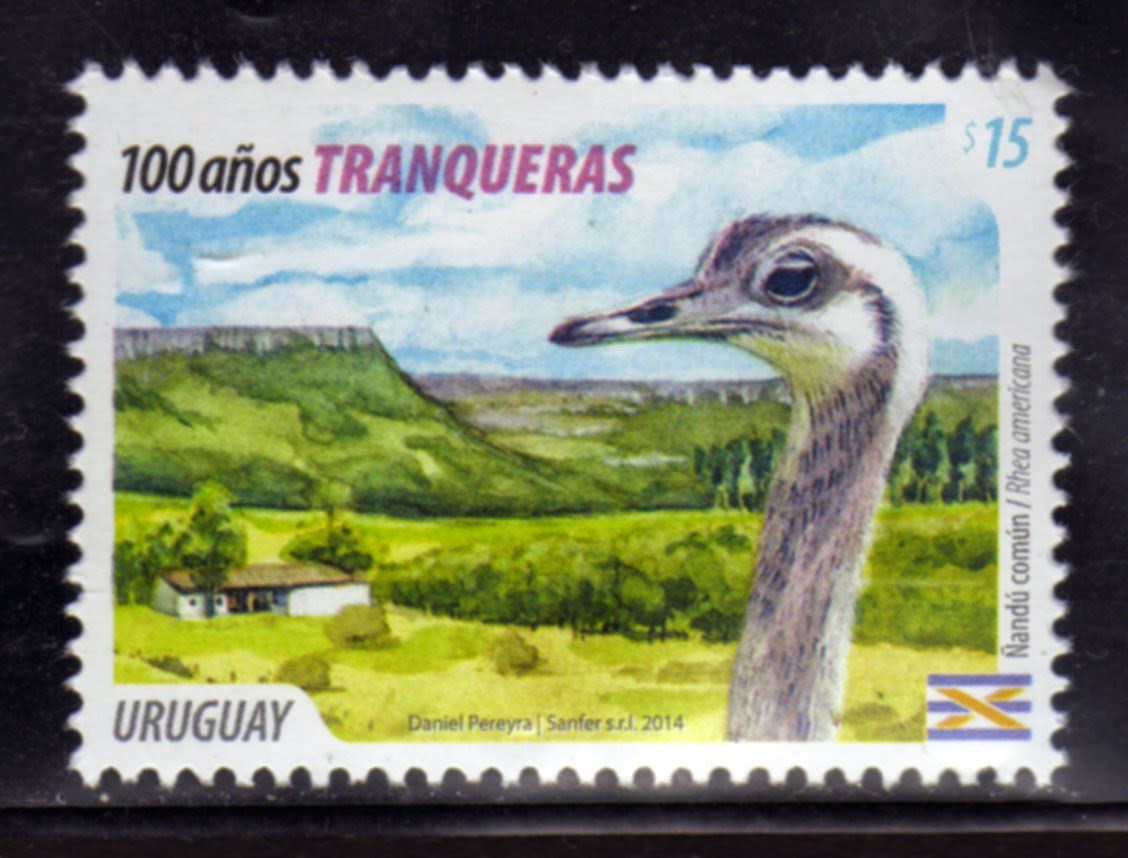
Uruguay - 2014 - Centenary of the City "Tranqueras" ( Previous
/ Next
)
Options:
SERIE
--- 1,00 EUR
SERIE
[2X2] --- 4,00 EUR
FDC
not Sent --- 2,00 EUR
FDC
Sent on First Day --- 9,00 EUR
COVER
Sent on First Day --- 7,00 EUR
If you are interested in any of this items, or any
other items from Uruguay, just make a donation including your e-mail in
the description.
I will contact you as soon I receive your donation, we agree on which
items do you need, and I will discount the donation done to the amount
of your purchase.
Issue information:
Country: Uruguay
Date: July 22nd, 2014
Printed: 15.000 copies
Stamp Shape and Size: Rectangular [39 mm. x 27
mm.]
Perforation: Circular
Gum: Water Activated
Block Configuration: 25 stamps [5 x 5]
Block Shape and Size: Rectangular [Unknown]
FDC Type: Official Cover from Post Office
FDC not sent Shape and Size: Rectangular [165 mm.
x 105 mm.]
FDC sent on issue day Shape and Size: Rectangular
[165 mm. x 105 mm.]
Cover Shape and Size: Rectangular [240 mm. x 160
mm.]
Catalogue information:
Michel: No Data Available
Ivert: No Data Available
Scott: No Data Available
Stanley & Gibbons: No Data Available
Topics:
Issue:
As Main Topic: I think Geography is
the most representative, also History could
be, and Centenaries
too.
Then, more in particular it Geography
of Uruguay, Cities
of Uruguay,
and the City of
Tranqueras itself, that in the stamp issue day began to be
a Centenary City,
and of course History of
Uruguay too as a concretization of the wider History Topic..
Then, surrounding the main topic, could be found the
followings: The Rivera
Department,
a department of the northern region of Uruguay, that has an
area of
9,370 km2 (3,620 sq mi) and a population of 103,493, and whose capital
city name is also Rivera,
because Tranqueras City
is located in that department.
Bridges and Rivers, could be
another topics for this release, as during the first decades of the
19th century the area was known as Paso
de Tranqueras because of the homonymous Bridge over the Tacuarembó Grande river.
Another Topics that emerges from Tranqueras
City History are: Trains,
Railways, France, and Personalities,
because French
Marcos Bourré
donated to the state some land for the construction of a Railway Station. The
arrival of the Railway
became the birth point of a village which grew rapidly with hotels,
stores and small industry. This cause that, on July 22nd of 1914 it
was declared a "Pueblo" (village) by the Act of Law Nº 5.107, and
on October 15th
of 1963, its status was elevated to "Villa" (town) by the
Act of Law Nº 13.167,
and finally, on December
13th of 1994, its status was elevated to "Ciudad" (city)
by the Act of Law Nº
16.667.
Now, regarding the desing of the stamp:
Besides reinforcing the Topic Geography
showing a Landscape
of Tranqueras City,
it also add two complete new topics.
The first are Geology
or Earth Science,
by showing a Plateau
in the background, surely one from the Sierra "Cuchilla Negra",
that is nearby the city.
And the second is quite obvious, as the Head of this Animal takes the
focus of the stamp, so Fauna
or Animals,
more precisely Birds
or Flightless Birds,
and in particular Greater
Rhea or Rhea
americana, also named Grey
Rhea, Common
Rhea, or American
rhea, and Ñandú
in Guaraní and Ema
in Portuguese.
One of two species in the Genus
Rhea, in the Family
Rheidae, the Greater
Rhea is endemic to Argentina, Bolivia, Brazil, Paraguay
and Uruguay. It inhabits a variety of open areas, such as Grasslands, Savanna or Grassy Wetlands.
Weighing 50–55 pounds (23–25 kg), the
Greater rhea is the largest bird in South America.
In the wild, the Greater
Rhea has a life expectancy of 10.5 years, It
is also notable for its reproductive habits, and for the fact the that
a group has established itself in Germany in recent
years.
The Greater Rhea
derives its scientific name from Rhea,
a Greek Goddess,
and the Latinized form of America. It was originally described by Carolus Linnaeus in
his 18th-century work, Systema
Naturae under the name Struthio
camelus americanus. He identified specimens from Sergipe, and Rio Grande do Norte,
Brazil, in
1758. They are from the Family
Rheidae, and the Order
Struthioniformes, commonly known as Ratites. They are
joined in this order by Emus,
Ostriches, Cassowaries, and Kiwis, along with
the extinct forms Moas,
and Elephant birds.
Rhea, as
the Greek Goddess,
is the Titaness daughter
of the earth goddess Gaia and the sky god Uranus and Sister and Wife to Cronos
in Greek mythology.
In early traditions, she is
known as "the mother of gods" and therefore is strongly associated with Gaia and Cybele,
who have similar functions. The classical Greeks saw her as the mother
of the Olympian goddesses and gods, but not as an Olympian goddess in
her own right. The
Romans identified her with Magna Mater (their form of Cybele), and the
Goddess Ops.
The design of the stamp, besides other components of a Countryside Landscape,
like Woods,
Trees, Bushes,
and a Farm House,
it also add the Flag of
the City of Tranqueras, so Flags Topic is
included in the release too.
The design of the Flag resembles the first "Tranquera", Farm Gate in
english, that gave name to this city, and it was selected, with over
60% of the votes, in August
of 2011, as the winner of the design creation of
Tranqueras flag. This design is the work of Miriam Darin, a plastic artist from Tranqueras, and it
cames the official Flag
of Tranqueras since November
30th of 2011 by an act of Law of the Departament Goverment of Rivera.
Finally, in a more symbolic way:
besides that all Centenaries,
specially in a Country relatively young as it is Uruguay, reinforces
the History,
and in this case the Uruguayan
History, Topic, I think that the selection of the Greater Rhea as the
main element of the stamp design, put the stamp focus on Fauna or Animals, and also in
Ecology, and
in particular the Care
of Extintion Threatened Animals, as the Greater Rhea is in
the Near Threatened
category, in The
IUCN Red List of Threatened Species, also known as the IUCN Red List or Red Data List, the World's most comprehensive
inventory of the global conservation status of biological species.
Then, also the almost wild environment shown in the stamp reinforces
the focus of the release in Ecology
Topic.
Block:
The block: Only reinforces the Flags Topic, and
could be also a very peculiar Doors
or Gates,
and an even peculiar and precise Farm
Gates, as the Flag
of the City of Tranqueras is the icon used to show the ink
colours
used in the printing of the stamps.
FDC:
The desing of the First Day Cancelation:
Is the Logotype
selected to promote the Centenary
of the City of Tranqueras.
By the design of this Logotype,
it adds to the release the Sun,
with it Stars
and Astronomy
Topics, also introduce Mountains
and not just Plateaus
as the stamp does, and reinforces the Farm Gates and Trees topics, with
the particulary that that for the last one, it is clearly shown one
particular type of Tree,
that is the Pine-Tree,
that are Conifer Trees,
in the Genus Pinus,
and in the Family
Pinaceae, that is the only Genus in the Subfamily Pinoideae.
If you consider that there are another topics in
this stamp, that were not spot in this review, you are encouraged to
telling me about them, so please do not hesitate to post a comment. I
would appreciate your help very much.