Showing posts with label Snake. Show all posts

Friday, June 19, 2015

URU - 2015 - #018 - BRIEF DESCRIPTION - COP12, RAMSAR CONVENTION FOR WETLANDS, PUNTA DEL ESTE 2015


Uruguay - 2015 - COP12: Ramsar International Convention for Wetlands, Punta del Este 2015 PreviousNext )


Options:

SERIES --- 10,00 EUR
STAMP 1 (Scarlet-headed Blackbird, Amblyramphus Holosericeus) --- 3,00 EUR
STAMP 2 (Black Skimmer, Rynchops Niger Intercedens) --- 3,00 EUR
STAMP 3 (Chilean Flamingo, Phoenicopterus Chilensis) --- 3,00 EUR
STAMP 4 (Snowy Egret, Egretta Thula) --- 3,00 EUR
STAMP 5 (Plumbeous Ibis, Theristicus Caerulescens) --- 3,00 EUR
STAMP 6 (Capybara, Hydrochoerus Hydrochaeris) --- 3,00 EUR
STAMP 7 (Saffron-Cowled Blackbird, Xanthopsar Flavus) --- 3,00 EUR
STAMP 8 (Brazilian Green Racer Snake, Philodryas Aestivus) --- 3,00 EUR
STAMP 9 (Neohelice Crab, Neohelice Granulatus) --- 3,00 EUR
STAMP 10 (Montevideo Red-Belly Toad, Melanophryniscus Montevidensis) --- 3,00 EUR
BLOCK --- 11,00 EUR
BLOCK with First Day Cancellation --- 12,00 EUR
BLOCK with Folder --- 15,00 EUR
 FDC not Sent of the whole Series (10 Covers)  --- 20,00 EUR
 FDC not Sent of STAMP 1 (Scarlet-headed Blackbird, Amblyramphus Holosericeus) --- 4,00 EUR
 FDC not Sent of STAMP 2 (Black Skimmer, Rynchops Niger Intercedens) --- 4,00 EUR
 FDC not Sent of STAMP 3 (Chilean Flamingo, Phoenicopterus Chilensis) --- 4,00 EUR
 FDC not Sent of STAMP 4 (Snowy Egret, Egretta Thula) --- 4,00 EUR
 FDC not Sent of STAMP 5 (Plumbeous Ibis, Theristicus Caerulescens) --- 4,00 EUR
 FDC not Sent of STAMP 6 (Capybara, Hydrochoerus Hydrochaeris) --- 4,00 EUR
 FDC not Sent of STAMP 7 (Saffron-Cowled Blackbird, Xanthopsar Flavus) --- 4,00 EUR
 FDC not Sent of STAMP 8 (Brazilian Green Racer Snake, Philodryas Aestivus) --- 4,00 EUR
 FDC not Sent of STAMP 9 (Neohelice Crab, Neohelice Granulatus) --- 4,00 EUR
 FDC not Sent of STAMP 10 (Montevideo Red-Belly Toad, Melanophryniscus Montevidensis) --- 4,00 EUR
FDC Sent on First Day of the whole Series (5 Covers) --- 35,00 EUR

If you are interested in any of this items, or any other items from Uruguay, just make a donation including your e-mail in the description.

I will contact you as soon I receive your donation, we agree on which items do you need, and I will discount the donation done to the amount of your purchase.


Issue information:

Country: Uruguay
Date: June 6th, 2015
Printed: 10.000 copies

Stamp Shape and Size: Both Rectangular [39 mm. x 27 mm.] extending it desing to perforations.
Perforation: Circular
Gum: Water Activated

Block Configuration: 1 series, 10 stamps [5 x 2]
[ [ Stamp 1, Empty Space, Stamp 2, Empty Space ]
[ Empty Space, Stamp 3, Empty Space, Stamp 4 ]
[ Stamp 5, Empty Space, Stamp 6, Empty Space ]
[ Empty Space, Stamp 7, Empty Space, Stamp 8 ]
[ Stamp 9, Empty Space, Stamp 10, Empty Space ] ]
Block Shape and Size: Rectangular [192 mm. x 191 mm.]

Folder Block Shape and Size: Rectangular [211 mm. x 200 mm.]

FDC Type: Official Cover from Post Office
FDC not sent Shape and Size: Rectangular [165 mm. x 105 mm.]
FDC sent on issue day Shape and Size: Rectangular [165 mm. x 105 mm.]


Catalogue information:

Michel: No Data Available
Ivert: No Data Available
Scott: No Data Available
Stanley & Gibbons: No Data Available

Topics:

Brief Description:

A brief description of the Most Popular Topics of this Release are: Ecology, in particular the one that takes care of Wetlands, and also International Conventions, as this Series was released to promote the 12th Meeting of the Conference of the Contracting Parties to the Ramsar Convention on Wetlands (COP12) that was held at the Conrad Resort, in Punta del Este, a city and resort on the Atlantic Coast in the Maldonado Department of southeastern Uruguay, from 1 to 9 June 2015.

Ramsar is the oldest of the modern global intergovernmental environmental agreements. The treaty was negotiated through the 1960s by countries and non-governmental organizations concerned about the increasing loss and degradation of wetland habitat for migratory waterbirds. It was adopted in the Iranian city of Ramsar in 1971 and came into force in 1975.

Then, looking at the desing of the Issue, many topics arises, most of them could be put inside the great category of Animals or Fauna, with a slight focus on Birds, as six of the Species selected for the Stamps in this Release, are in this particular Family of Animals, however the Spectre inside this family is wide going from two different small Blackbirds as Scarlet-headed Blackbird, Amblyramphus Holosericeus and Saffron-Cowled Blackbird, Xanthopsar Flavus, to bigger birds like: Black Skimmer, Rynchops Niger Intercedens; Chilean Flamingo, Phoenicopterus Chilensis; Snowy Egret, Egretta Thula; and Plumbeous Ibis, Theristicus Caerulescens. Then, Mammals, and in particular Roedents are represented by the Biggest Roedent of the World, the Capybara, Hydrochoerus Hydrochaeris. Also Crustaceans, in partcular Crabs are present too with the inclusion of Neohelice Crab, Neohelice Granulatus. And finally, Reptiles mades it appeareance through Snakes and Toads Individuals, as are the Brazilian Green Racer Snake, Philodryas Aestivus and Montevideo Red-Belly Toad, Melanophryniscus Montevidensis respectively.

All these Animals are beautifully presented in a typical view of a Wetland, including all it characteristic Flora, like Reeds, Water Lilies, and other Plants and Trees that are common in this kind of Geography.

Finally, just a few words regarding the Logotypes that appears in this Release. In all items, the Block, the First Day Cancellation and the Folder, the Logo of the Ramsar Convention in Punta del Este is included, showing in a stylized form: The Sun, The Water, and also a Capybara, a large Bird probably a Snowy Egret, and Reeds. All these items accompanied by the Motto of the Convention that is "Humedales para nuestro futuro", that means "Wetlands for our future". Then, also the Logotypes of "Uruguay Natural", a Brand that promotes Uruguay as Environment Friendly Country, and the one of MVOTMA, that stands for "Ministerio de Vivienda, Ordenamiento Territorial, y Medio Ambiente", that is the Uruguayan Ministry that has Ecology as one of its responsabilities, appears both in the Block and in the Folder of the Release.


If you consider that there are another topics in this stamp, that were not spot in this review, you are encouraged to telling me about them, so please do not hesitate to post a comment. I would appreciate your help very much.

Monday, April 7, 2014

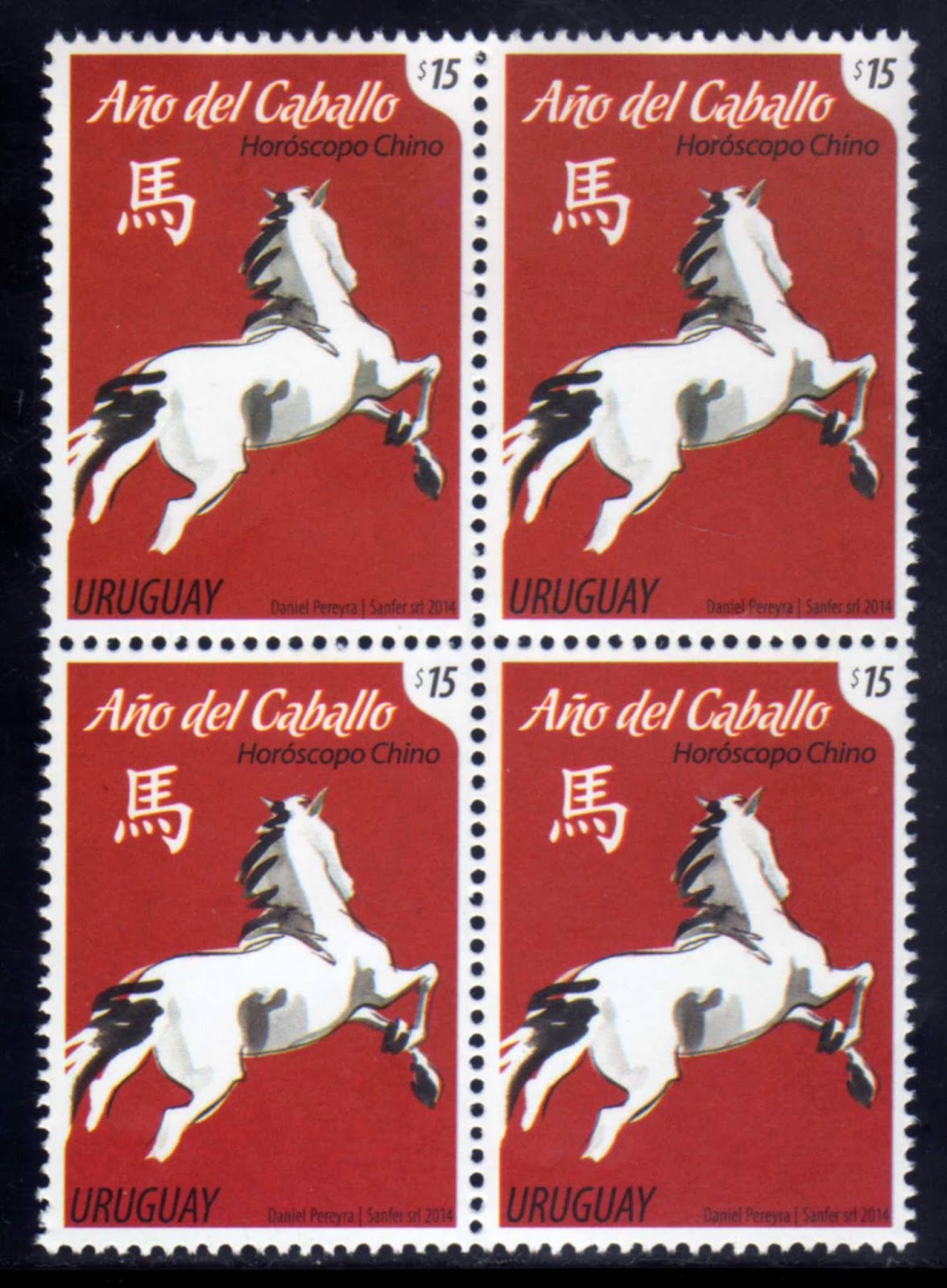
URU - 2014 - #001 - SERIE - CHINESE HOROSCOPE, YEAR OF THE HORSE


Uruguay - 2014 - Chinese Horoscope, Year of the Horse ( PreviousNext )


Options:

SERIE --- 1,00 EUR
SERIE [2X2] --- 4,00 EUR
BLOCK --- 9,00 EUR
FDC not Sent --- 2,00 EUR
FDC not Sent with Special Cover --- 2,50 EUR
FDC Sent on First Day --- 7,00 EUR (Already Sold)
COVER Sent on First Day --- 5,00 EUR (Already Sold)

If you are interested in any of this items, or any other items from Uruguay, just make a donation including your e-mail in the description.

I will contact you as soon I receive your donation, we agree on which items do you need, and I will discount the donation done to the amount of your purchase.


Issue information:

Country: Uruguay
Date: January 31st, 2014
Printed: 15.003 copies

Stamp Shape and Size: Rectangular [27 mm. x 39 mm.]
Perforation: Circular
Gum: Water Activated

Block Configuration: 9 stamps [3 x 1 + 3 x 2] with a separation between stamp blocks
Block Shape and Size: Rectangular [170 mm. x 193 mm.]

FDC Type: Cover special for this issue (however, in this case it was not ready the first day of issue)
FDC not sent Shape and Size: Rectangular [166 mm. x 90 mm.]
FDC sent on issue day Shape and Size: Rectangular [165 mm. x 105 mm.]

Cover Shape and Size: Rectangular [240 mm. x 160 mm.]

Catalogue information:

Michel: No Data Available
Ivert: No Data Available
Scott: No Data Available
Stanley & Gibbons: No Data Available

Topics:

Issue:

As Main Topic: The Chinese Horoscope, or Chinese Zodiac, that is based on the Chinese Calendar, and in particular his Year of the Horse , even more particularly, and although not specified in the issue, The Year of the Wood Horse

Then, surrounding the main topic: Could be found the followings: Clearly Astrology. Then, from general to particular, Measuring Systems, Time Measuring Systems, Calendars. Also, the more abstract Time itself. And, of course China as the country, or more in general the Eastern Culture.

Now, regarding the desing of the stamp: It is clear that The Horse, in particular from a Wider Animals or Fauna, is the most relevant topic of the issue. Then Chinese Characterers could be another, as it is not usual to see them in western stamps. Finally, The Sketching, as a way of Painting, inside an Art Topic, could be spotted.

Finally, in a more symbolic way: The particular attitude of the horse sketched in the stamp, and the figure of a Horse itself, inspires: Freedom, Strength, Power, Beauty, Nature.


Block:

The block: Adds some more topics by his design: The most visible one could be the inclusion of Flowers from a Trees, from the world of Plants, Vegetables, or Flora. Then, it also adds, at the bottom of the block, the other eleven animals from the Chinese Calendar, that are: Rat, Ox, Tiger, Rabbit, Dragon, Snake, Goat, Monkey, Rooster, Dog, and Pig. And regarding to Painting methods or styles, now it appears the Aquarelle or Watercolour in the main painting of the block, and the Caricature for the animals at the bottom of the block.

Again, in a more symbolic way: The scene of the tree with flowers in watercolour, inspires also: Peacefullness, Equilibrium, Oneness.


FDC:

The desing of the First Day Cancelation: Probably it not add a new Topic by itself, however, it could be remarked that it present the Taijitu, the symbol of Ying and Yang, that as it was said regarding the Chinese Characters, it is rarely seen in western stamps, and could be useful in an eventual collection about Signs.

Then, the way in which is represented in the cancelation, the black part of the Taijitu, resemples Water Waves.


If you consider that there are another topics in this stamp, that were not spot in this review, you are encouraged to telling me about them, so please do not hesitate to post a comment. I would appreciate your help very much.

URU - 2014 - #001 - COVER Sent on First Day - CHINESE HOROSCOPE, YEAR OF THE HORSE


Uruguay - 2014 - Chinese Horoscope, Year of the Horse


If you are interested in any of this items, or any other items from Uruguay, just make a donation including your e-mail in the description.

I will contact you as soon I receive your donation, we agree on which items do you need, and I will discount the donation done to the amount of your purchase.


URU - 2014 - #001 - FDC Sent on First Day - CHINESE HOROSCOPE, YEAR OF THE HORSE


Uruguay - 2014 - Chinese Horoscope, Year of the Horse


If you are interested in any of this items, or any other items from Uruguay, just make a donation including your e-mail in the description.

I will contact you as soon I receive your donation, we agree on which items do you need, and I will discount the donation done to the amount of your purchase.


URU - 2014 - #001 - FDC DECORATED not Sent - CHINESE HOROSCOPE, YEAR OF THE HORSE


Uruguay - 2014 - Chinese Horoscope, Year of the Horse


If you are interested in any of this items, or any other items from Uruguay, just make a donation including your e-mail in the description.

I will contact you as soon I receive your donation, we agree on which items do you need, and I will discount the donation done to the amount of your purchase.


URU - 2014 - #001 - FDC not Sent - CHINESE HOROSCOPE, YEAR OF THE HORSE


Uruguay - 2014 - Chinese Horoscope, Year of the Horse


If you are interested in any of this items, or any other items from Uruguay, just make a donation including your e-mail in the description.

I will contact you as soon I receive your donation, we agree on which items do you need, and I will discount the donation done to the amount of your purchase.


URU - 2014 - #001 - BLOCK - CHINESE HOROSCOPE, YEAR OF THE HORSE


Uruguay - 2014 - Chinese Horoscope, Year of the Horse


If you are interested in any of this items, or any other items from Uruguay, just make a donation including your e-mail in the description.

I will contact you as soon I receive your donation, we agree on which items do you need, and I will discount the donation done to the amount of your purchase.


URU - 2014 - #001 - SERIE [2x2] - CHINESE HOROSCOPE, YEAR OF THE HORSE


Uruguay - 2014 - Chinese Horoscope, Year of the Horse


If you are interested in any of this items, or any other items from Uruguay, just make a donation including your e-mail in the description.

I will contact you as soon I receive your donation, we agree on which items do you need, and I will discount the donation done to the amount of your purchase.


URU - 2014 - #001 - SERIE - CHINESE HOROSCOPE, YEAR OF THE HORSE


Uruguay - 2014 - Chinese Horoscope, Year of the Horse ( PreviousNext )


Options:

SERIE --- 1,00 EUR
SERIE [2X2] --- 4,00 EUR
BLOCK --- 9,00 EUR
FDC not Sent --- 2,00 EUR
FDC not Sent with Special Cover --- 2,50 EUR
FDC Sent on First Day --- 7,00 EUR (Already Sold)
COVER Sent on First Day --- 5,00 EUR (Already Sold)

If you are interested in any of this items, or any other items from Uruguay, just make a donation including your e-mail in the description.

I will contact you as soon I receive your donation, we agree on which items do you need, and I will discount the donation done to the amount of your purchase.


Issue information:

Country: Uruguay
Date: January 31st, 2014
Printed: 15.003 copies

Stamp Shape and Size: Rectangular [27 mm. x 39 mm.]
Perforation: Circular
Gum: Water Activated

Block Configuration: 9 stamps [3 x 1 + 3 x 2] with a separation between stamp blocks
Block Shape and Size: Rectangular [170 mm. x 193 mm.]

FDC Type: Cover special for this issue (however, in this case it was not ready the first day of issue)
FDC not sent Shape and Size: Rectangular [166 mm. x 90 mm.]
FDC sent on issue day Shape and Size: Rectangular [165 mm. x 105 mm.]

Cover Shape and Size: Rectangular [240 mm. x 160 mm.]

Catalogue information:

Michel: No Data Available
Ivert: No Data Available
Scott: No Data Available
Stanley & Gibbons: No Data Available

Topics:

Issue:

As Main Topic: The Chinese Horoscope, or Chinese Zodiac, that is based on the Chinese Calendar, and in particular his Year of the Horse , even more particularly, and although not specified in the issue, The Year of the Wood Horse

Then, surrounding the main topic: Could be found the followings: Clearly Astrology. Then, from general to particular, Measuring Systems, Time Measuring Systems, Calendars. Also, the more abstract Time itself. And, of course China as the country, or more in general the Eastern Culture.

Now, regarding the desing of the stamp: It is clear that The Horse, in particular from a Wider Animals or Fauna, is the most relevant topic of the issue. Then Chinese Characterers could be another, as it is not usual to see them in western stamps. Finally, The Sketching, as a way of Painting, inside an Art Topic, could be spotted.

Finally, in a more symbolic way: The particular attitude of the horse sketched in the stamp, and the figure of a Horse itself, inspires: Freedom, Strength, Power, Beauty, Nature.


Block:

The block: Adds some more topics by his design: The most visible one could be the inclusion of Flowers from a Trees, from the world of Plants, Vegetables, or Flora. Then, it also adds, at the bottom of the block, the other eleven animals from the Chinese Calendar, that are: Rat, Ox, Tiger, Rabbit, Dragon, Snake, Goat, Monkey, Rooster, Dog, and Pig. And regarding to Painting methods or styles, now it appears the Aquarelle or Watercolour in the main painting of the block, and the Caricature for the animals at the bottom of the block.

Again, in a more symbolic way: The scene of the tree with flowers in watercolour, inspires also: Peacefullness, Equilibrium, Oneness.


FDC:

The desing of the First Day Cancelation: Probably it not add a new Topic by itself, however, it could be remarked that it present the Taijitu, the symbol of Ying and Yang, that as it was said regarding the Chinese Characters, it is rarely seen in western stamps, and could be useful in an eventual collection about Signs.

Then, the way in which is represented in the cancelation, the black part of the Taijitu, resemples Water Waves.


If you consider that there are another topics in this stamp, that were not spot in this review, you are encouraged to telling me about them, so please do not hesitate to post a comment. I would appreciate your help very much.

Friday, August 30, 2013

URU - 2013 - #012 - SERIE - DAY OF PATIENT SAFETY


Uruguay - 2013 - Day of Patient Safety


Options:

SERIE --- 1,40 EUR
SERIE [2X2] --- 5,50 EUR
BLOCK --- 12,00 EUR
FDC not Sent --- 2,80 EUR
FDC Sent on First Day --- 9,00 EUR
COVER Sent on First Day --- 6,00 EUR

If you are interested in any of this items, or any other items from Uruguay, just make a donation including your e-mail in the description.

I will contact you as soon I receive your donation, we agree on which items do you need, and I will discount the donation done to the amount of your purchase.


Issue information:

Country: Uruguay
Date: April 11th, 2013
Printed: 15.003 copies

Stamp Shape and Size: Rectangular [27 mm. x 39 mm.]
Perforation: Circular
Gum: Water Activated

Block Configuration: 9 stamps [3 x 3]
Block Shape and Size: Rectangular [110 mm. x 150 mm.]

FDC Type: Normal
FDC Shape and Size: Rectangular [165 mm. x 105 mm.]
Cover Shape and Size: Rectangular [241 mm. x 159 mm.]

Catalogue information:

Michel: No Data Available
Ivert: No Data Available
Scott: No Data Available
Stanley & Gibbons: No Data Available

Topics:

Issue:

This stamp commemorates the national day of the Patient Safety, that is planned to occur on April 14th of each year, since the year that the stamp was released, as a consequence of a draft legislation aleady voted positive by unanimity, and still not established by law.

This draft legislation states that all institution that provides health services, will implement this day several activities in all his location to raise awareness of the relevance of the activities that improve Patient Safety.

The desing of the stamp shows mainly the logotype created for that day by the Association named "Rodrigo Aguirre Camblor - Cuidar la vida", in english "Rodrigo Aguirre Camblor - Life Care", that it is an association created by the mother Rodrigo Aguirre Camblor, after the tragic death of Rodrigo in a case of medical malpractice, and that is focus in conscientization of this problematic, in order to diminish the incidence of malpractice in health institutions.

This logotype shows a spheric map of the world, and over it, in his center, the Rod of Asclepius, the serpent-entwined rod wielded by the Greek god Asclepius, a deity associated with healing and medicine.

It also add the legend: "Educar en prevención - Control - Corrección", that in english means: "Education on prevention - Checking - Correction", that is the motto of the Association.

Finally, the desing of the stamp is completed with the classic ribbon for activism in causes, this time in collor green, and both the ribbon and the Association logotype in a background of yellow green gradient.

This Day of Patient Safety referred by this stamp is an uruguayan only special day, not an international one, and the selection of the date April 14th for it, was because that in that day was born Rodrigo Aguirre, the victim of medical malpractice already mentioned.

It also exist a proposal from the "Colegio Internacional de Enfermeras", the International Association of Nurses, to establish an international day of patient safety, on each July 25th, however, until now, no other international organization is considering it.

Rodrigo Aguirre Camblor was born on April 14t of 1983, and passed away on 2007 by the consequence of medical malpractice.

The tragedy of Rodrigo Aguirre, was a well known case of malpractice, because of the Association created by his mother, and also, because of the parentage he has to the well known soccer player and coach Diego Aguirre, Southamerican champion as a player with uruguayan team Peñarol, and also finalist of the Southamerican cup with the same team as coach. Rodrigo Aguirre was a younger brother of Diego Aguirre.

Patient safety is a new healthcare discipline that emphasizes the reporting, analysis, and prevention of medical error that often leads to adverse healthcare events. The frequency and magnitude of avoidable adverse patient events was not well known until the 1990s, when multiple countries reported staggering numbers of patients harmed and killed by medical errors. Recognizing that healthcare errors impact 1 in every 10 patients around the world, the World Health Organization calls patient safety an endemic concern. Indeed, patient safety has emerged as a distinct healthcare discipline supported by an immature yet developing scientific framework. There is a significant transdisciplinary body of theoretical and research literature that informs the science of patient safety. The resulting patient safety knowledge continually informs improvement efforts such as: applying lessons learned from business and industry, adopting innovative technologies, educating providers and consumers, enhancing error reporting systems, and developing new economic incentives.

Millennia ago, Hippocrates recognized the potential for injuries that arise from the well intentioned actions of healers. Greek healers in the 4th Century B.C., drafted the Hippocratic Oath and pledged to "prescribe regimens for the good of my patients according to my ability and my judgment and never do harm to anyone." Since then, the directive primum non nocere (“first do no harm) has become a central tenet for contemporary medicine. However, despite an increasing emphasis on the scientific basis of medical practice in Europe and the United States in the late 19th Century, data on adverse outcomes were hard to come by and the various studies commissioned collected mostly anecdotal events.

In the United States, the public and the medical specialty of anesthesia were shocked in April 1982 by the ABC television program 20/20 entitled The Deep Sleep. Presenting accounts of anesthetic accidents, the producers stated that, every year, 6,000 Americans die or suffer brain damage related to these mishaps. In 1983, the British Royal Society of Medicine and the Harvard Medical School jointly sponsored a symposium on anesthesia deaths and injuries, resulting in an agreement to share statistics and to conduct studies. By 1984 the American Society of Anesthesiologists (ASA) had established the Anesthesia Patient Safety Foundation (APSF). The APSF marked the first use of the term "patient safety" in the name of professional reviewing organization. Although anesthesiologists comprise only about 5% of physicians in the United States, anesthesiology became the leading medical specialty addressing issues of patient safety. Likewise in Australia, the Australian Patient Safety Foundation was founded in 1989 for anesthesia error monitoring. Both organizations were soon expanded as the magnitude of the medical error crisis became known.

In Greek mythology, the Rod of Asclepius (sometimes also spelled Asklepios or Aesculapius), also known as the asklepian, is a serpent-entwined rod wielded by the Greek god Asclepius, a deity associated with healing and medicine. The symbol has continued to be used in modern times, where it is associated with medicine and health care, yet frequently confused with the staff of the god Hermes, the caduceus. Theories have been proposed about the Greek origin of the symbol and its implications.

The most famous temple of Asclepius was at Epidaurus in north-eastern Peloponnese. Another famous healing temple (or asclepieion) was located on the island of Kos, where Hippocrates, the legendary "father of medicine", may have begun his career. Other asclepieia were situated in Trikala, Gortys (in Arcadia), and Pergamum in Asia.

In honor of Asclepius, a particular type of non-venomous snake was often used in healing rituals, and these snakes — the Aesculapian Snakes — crawled around freely on the floor in dormitories where the sick and injured slept. These snakes were introduced at the founding of each new temple of Asclepius throughout the classical world. From about 300 BC onwards, the cult of Asclepius grew very popular and pilgrims flocked to his healing temples (Asclepieia) to be cured of their ills. Ritual purification would be followed by offerings or sacrifices to the god (according to means), and the supplicant would then spend the night in the holiest part of the sanctuary - the abaton (or adyton). Any dreams or visions would be reported to a priest who would prescribe the appropriate therapy by a process of interpretation. Some healing temples also used sacred dogs to lick the wounds of sick petitioners.

The original Hippocratic Oath began with the invocation "I swear by Apollo the Physician and by Asclepius and by Hygieia and Panacea and by all the gods ..."

The serpent and the staff appear to have been separate symbols that were combined at some point in the development of the Asclepian cult. The significance of the serpent has been interpreted in many ways; sometimes the shedding of skin and renewal is emphasized as symbolizing rejuvenation, while other assessments center on the serpent as a symbol that unites and expresses the dual nature of the work of the physician, who deals with life and death, sickness and health. The ambiguity of the serpent as a symbol, and the contradictions it is thought to represent, reflect the ambiguity of the use of drugs, which can help or harm, as reflected in the meaning of the term pharmakon, which meant "drug", "medicine" and "poison" in ancient Greek. Products deriving from the bodies of snakes were known to have medicinal properties in ancient times, and in ancient Greece, at least some were aware that snake venom that might be fatal if it entered the bloodstream could often be imbibed. Snake venom appears to have been 'prescribed' in some cases as a form of therapy.

The staff has also been variously interpreted. One view is that it, like the serpent, "conveyed notions of resurrection and healing", while another (not necessarily incompatible) is that the staff was a walking stick associated with itinerant physicians. Cornutus, a Greek philosopher probably active in the first century CE, in the Theologiae Graecae Compendium (Ch. 33) offers a view of the significance of both snake and staff:

Asclepius derived his name from healing soothingly and from deferring the withering that comes with death. For this reason, therefore, they give him a serpent as an attribute, indicating that those who avail themselves of medical science undergo a process similar to the serpent in that they, as it were, grow young again after illnesses and slough off old age; also because the serpent is a sign of attention, much of which is required in medical treatments. The staff also seems to be a symbol of some similar thing. For by means of this it is set before our minds that unless we are supported by such inventions as these, in so far as falling continually into sickness is concerned, stumbling along we would fall even sooner than necessary.

In any case the two symbols certainly merged in antiquity as representations of the snake coiled about the staff are common. It has been claimed that the snake wrapped around the staff was a species of rat snake, Elaphe longissima.

A number of organizations and services use the rod of Asclepius as their logo, or part of their logo.

It is relatively common, especially in the United States, to find the caduceus, with its two snakes and wings, used as a symbol of medicine instead of the correct Rod of Asclepius, with only a single snake. This usage is erroneous, popularised largely as a result of the adoption of the caduceus as its insignia by the U.S. Army Medical Corps in 1902 at the insistence of a single officer (though there are conflicting claims as to whether this was Capt. Frederick P. Reynolds or Col. John R. van Hoff).

The rod of Asclepius is the dominant symbol for professional healthcare associations in the United States. One survey found that 62% of professional healthcare associations used the rod of Asclepius as their symbol. The same survey found that 76% of commercial healthcare organizations used the Caduceus symbol. The author of the study suggests the difference exists because professional associations are more likely to have a real understanding of the two symbols, whereas commercial organizations are more likely to be concerned with the visual impact a symbol will have in selling their products.

Asclepius is the god of medicine and healing in ancient Greek religion. Asclepius represents the healing aspect of the medical arts; his daughters are Hygieia ("Hygiene", the goddess/personification of health, cleanliness, and sanitation), Iaso (the goddess of recuperation from illness), Aceso (the goddess of the healing process), Aglæa/Ægle (the goddess of beauty, splendor, glory, magnificence, and adornment), and Panacea (the goddess of universal remedy). He was associated with the Roman/Etruscan god Vediovis. He was one of Apollo's sons, sharing with Apollo the epithet Paean ("the Healer"). The rod of Asclepius, a snake-entwined staff, remains a symbol of medicine today.

He was the son of Apollo and Coronis. His mother was killed for being unfaithful to Apollo and was laid out on a funeral pyre to be consumed, but the unborn child was rescued from her womb. Or, alternatively, his mother died in labor and was laid out on the pyre to be consumed, but his father rescued the child, cutting him from her womb. From this he received the name Asklepios, "to cut open.", Apollo carried the baby to the centaur Chiron who raised Asclepius and instructed him in the art of medicine.

Asclepius was married to Epione, with whom he had six daughters: Hygieia, Meditrina (the serpent-bearer),[disambiguation needed] Panacea, Aceso, Iaso, and Aglaea,[6][7] and three sons: Machaon, Podaleirios and Telesphoros. He also sired a son, Aratus, with Aristodama. The names of his daughters each rather transparently reflect a certain subset of the overall theme of "good health"

At some point, Asclepius was among those who took part in the Calydonian Boar hunt.

Zeus killed Asclepius with a thunderbolt because he raised Hippolytus from the dead and accepted gold for it. Other stories say that Asclepius was killed because after bringing people back from the dead, Hades thought that no more dead spirits would come to the underworld, so he asked his brother Zeus to remove him. This angered Apollo who in turn murdered the Cyclopes who had made the thunderbolts for Zeus. For this act, Zeus suspended Apollo from the night sky and commanded Apollo to serve Admetus, King of Thessaly for a year. Once the year had passed, Zeus brought Apollo back to Mount Olympus and revived the Cyclopes that made his thunderbolts. After Asclepius' death, Zeus placed his body among the stars as the constellation Ophiuchus ("the Serpent Holder").

Some sources also stated that Asclepius was later resurrected as a god by Zeus to prevent any further feuds with Apollo.

Greek mythology is the body of myths and teachings that belong to the ancient Greeks, concerning their gods and heroes, the nature of the world, and the origins and significance of their own cult and ritual practices. It was a part of the religion in ancient Greece. Modern scholars refer to and study the myths in an attempt to throw light on the religious and political institutions of Ancient Greece and its civilization, and to gain understanding of the nature of myth-making itself.

Greek mythology is explicitly embodied in a large collection of narratives, and implicitly in Greek representational arts, such as vase-paintings and votive gifts. Greek myth attempts to explain the origins of the world, and details the lives and adventures of a wide variety of gods, goddesses, heroes, heroines, and mythological creatures. These accounts initially were disseminated in an oral-poetic tradition; today the Greek myths are known primarily from Greek literature.

The oldest known Greek literary sources, Homer's epic poems Iliad and Odyssey, focus on the Trojan War and its aftermath. Two poems by Homer's near contemporary Hesiod, the Theogony and the Works and Days, contain accounts of the genesis of the world, the succession of divine rulers, the succession of human ages, the origin of human woes, and the origin of sacrificial practices. Myths are also preserved in the Homeric Hymns, in fragments of epic poems of the Epic Cycle, in lyric poems, in the works of the tragedians of the fifth century BC, in writings of scholars and poets of the Hellenistic Age, and in texts from the time of the Roman Empire by writers such as Plutarch and Pausanias.

Archaeological findings provide a principal source of detail about Greek mythology, with gods and heroes featured prominently in the decoration of many artifacts. Geometric designs on pottery of the eighth century BC depict scenes from the Trojan cycle as well as the adventures of Heracles. In the succeeding Archaic, Classical, and Hellenistic periods, Homeric and various other mythological scenes appear, supplementing the existing literary evidence. Greek mythology has had an extensive influence on the culture, arts, and literature of Western civilization and remains part of Western heritage and language. Poets and artists from ancient times to the present have derived inspiration from Greek mythology and have discovered contemporary significance and relevance in the themes.

The Aesculapian Snake (now Zamenis longissimus, previously Elaphe longissima), a member of the Colubrinae subfamily of the family Colubridae, is a nonvenomous snake native to Europe. With up to 2 meters in length, it counts among the largest European snakes, though not as massive as the Four-lined Snake or the Montpellier Snake. The species has been of cultural and historical significance for its role in ancient Greek and Roman mythology and derived symbolism.

The snakes hatch at around 30 cm (11.8 in) and average at around 110 cm (43.3 in) to 150 cm (59 in) but can grow up to 200 cm (79 in) (225 cm (89 in)). They are dark, long, slender, and typically about bronze in color with smooth scales that give them a metallic sheen.

Juveniles can easily be confused with juvenile Grass Snakes, also having a yellow collar on their neck that may persist for some time in younger adults. They are light green or brownish-green with various darker patterns along the flanks and on their back. Two darker patches appear in the form of lines running on the top of the flanks. The head in juveniles also features several distinctive dark spots, one hoof-like on the back of the head in-between the yellow neck stripes, and two paired ones, thereof one horizontal stripe running from the eye and connecting to the neck marks, and one short vertical stripe connecting the eye with the 4th to 5th mouth (supralabial) scales.

Adults are much more uniform, sometimes being olive-yellow, brownish-green, sometimes almost black. Often in adults, there may be a more or less regular pattern of white-edged dorsal scales appearing as white freckles all over the body up to moire-like structures in places, enhancing the shiny metallic appearance. Sometimes especially when pale in color, two darker longitudinal lines along the flanks can be visible. The belly is plain yellow to off-white while the round iris has amber to ochre coloration. Both melanistic and albinotic natural forms are known, as is a dark grey form and even erythristic specimen.

Although there is no noticeable sexual dimorphism in coloration, males grow significantly longer than females, presumably because of the more significant energy input of the latter into the reproductive cycle. Maximum weight for German populations has been 890g for males and 550g for females (Böhme 1993; Gomille 2002). Other distinctions, as in many snakes, include relatively longer tail to total body length and a wider tail base in males.

Scale arrangement includes 23 scale rows at mid body (rarely 19 or 21), 211-250 ventral scales, a divided anal scale and 60-91 paired caudal scales (Schultz 1996; Arnold 2002). Ventral scales are sharply angled where the underside meets the body, which enhances the species' climbing ability.

Lifespan is estimated at about 25 to 30 years.


Block:

The block is only decorated with four Rods of Asclepius, to show the inks used in printing, and the legend of the centenary of the release "14 de Abril - Día de la Seguridad del Paciente", that it translation to english is "April 14th - Day of Patient Safety".


FDC:

The desing of the First Day Cancelation, shows only the same logotype already included in the stamp, that was builded by the "Rodrigo Aguirre Camblor - Cuidar la vida" Association for this special day, and it shows mainly the world map with the Rods of Asclepius in his center.


If you consider that there are another topics in this stamp, that were not spot in this review, you are encouraged to telling me about them, so please do not hesitate to post a comment. I would appreciate your help very much.

URU - 2013 - #012 - COVER Sent on First Day - DAY OF PATIENT SAFETY


Uruguay - 2013 - Day of Patient Safety


If you are interested in any of this items, or any other items from Uruguay, just make a donation including your e-mail in the description.

I will contact you as soon I receive your donation, we agree on which items do you need, and I will discount the donation done to the amount of your purchase.


URU - 2013 - #012 - FDC Sent on First Day - DAY OF PATIENT SAFETY


Uruguay - 2013 - Day of Patient Safety


If you are interested in any of this items, or any other items from Uruguay, just make a donation including your e-mail in the description.

I will contact you as soon I receive your donation, we agree on which items do you need, and I will discount the donation done to the amount of your purchase.


URU - 2013 - #012 - FDC not Sent - DAY OF PATIENT SAFETY


Uruguay - 2013 - Day of Patient Safety


If you are interested in any of this items, or any other items from Uruguay, just make a donation including your e-mail in the description.

I will contact you as soon I receive your donation, we agree on which items do you need, and I will discount the donation done to the amount of your purchase.


URU - 2013 - #012 - BLOCK - DAY OF PATIENT SAFETY


Uruguay - 2013 - Day of Patient Safety


If you are interested in any of this items, or any other items from Uruguay, just make a donation including your e-mail in the description.

I will contact you as soon I receive your donation, we agree on which items do you need, and I will discount the donation done to the amount of your purchase.


URU - 2013 - #012 - SERIE [2x2] - DAY OF PATIENT SAFETY


Uruguay - 2013 - Day of Patient Safety


If you are interested in any of this items, or any other items from Uruguay, just make a donation including your e-mail in the description.

I will contact you as soon I receive your donation, we agree on which items do you need, and I will discount the donation done to the amount of your purchase.


URU - 2013 - #012 - SERIE - DAY OF PATIENT SAFETY


Uruguay - 2013 - Day of Patient Safety


Options:

SERIE --- 1,40 EUR
SERIE [2X2] --- 5,50 EUR
BLOCK --- 12,00 EUR
FDC not Sent --- 2,80 EUR
FDC Sent on First Day --- 9,00 EUR
COVER Sent on First Day --- 6,00 EUR

If you are interested in any of this items, or any other items from Uruguay, just make a donation including your e-mail in the description.

I will contact you as soon I receive your donation, we agree on which items do you need, and I will discount the donation done to the amount of your purchase.


Issue information:

Country: Uruguay
Date: April 11th, 2013
Printed: 15.003 copies

Stamp Shape and Size: Rectangular [27 mm. x 39 mm.]
Perforation: Circular
Gum: Water Activated

Block Configuration: 9 stamps [3 x 3]
Block Shape and Size: Rectangular [110 mm. x 150 mm.]

FDC Type: Normal
FDC Shape and Size: Rectangular [165 mm. x 105 mm.]
Cover Shape and Size: Rectangular [241 mm. x 159 mm.]

Catalogue information:

Michel: No Data Available
Ivert: No Data Available
Scott: No Data Available
Stanley & Gibbons: No Data Available

Topics:

Issue:

This stamp commemorates the national day of the Patient Safety, that is planned to occur on April 14th of each year, since the year that the stamp was released, as a consequence of a draft legislation aleady voted positive by unanimity, and still not established by law.

This draft legislation states that all institution that provides health services, will implement this day several activities in all his location to raise awareness of the relevance of the activities that improve Patient Safety.

The desing of the stamp shows mainly the logotype created for that day by the Association named "Rodrigo Aguirre Camblor - Cuidar la vida", in english "Rodrigo Aguirre Camblor - Life Care", that it is an association created by the mother Rodrigo Aguirre Camblor, after the tragic death of Rodrigo in a case of medical malpractice, and that is focus in conscientization of this problematic, in order to diminish the incidence of malpractice in health institutions.

This logotype shows a spheric map of the world, and over it, in his center, the Rod of Asclepius, the serpent-entwined rod wielded by the Greek god Asclepius, a deity associated with healing and medicine.

It also add the legend: "Educar en prevención - Control - Corrección", that in english means: "Education on prevention - Checking - Correction", that is the motto of the Association.

Finally, the desing of the stamp is completed with the classic ribbon for activism in causes, this time in collor green, and both the ribbon and the Association logotype in a background of yellow green gradient.

This Day of Patient Safety referred by this stamp is an uruguayan only special day, not an international one, and the selection of the date April 14th for it, was because that in that day was born Rodrigo Aguirre, the victim of medical malpractice already mentioned.

It also exist a proposal from the "Colegio Internacional de Enfermeras", the International Association of Nurses, to establish an international day of patient safety, on each July 25th, however, until now, no other international organization is considering it.

Rodrigo Aguirre Camblor was born on April 14t of 1983, and passed away on 2007 by the consequence of medical malpractice.

The tragedy of Rodrigo Aguirre, was a well known case of malpractice, because of the Association created by his mother, and also, because of the parentage he has to the well known soccer player and coach Diego Aguirre, Southamerican champion as a player with uruguayan team Peñarol, and also finalist of the Southamerican cup with the same team as coach. Rodrigo Aguirre was a younger brother of Diego Aguirre.

Patient safety is a new healthcare discipline that emphasizes the reporting, analysis, and prevention of medical error that often leads to adverse healthcare events. The frequency and magnitude of avoidable adverse patient events was not well known until the 1990s, when multiple countries reported staggering numbers of patients harmed and killed by medical errors. Recognizing that healthcare errors impact 1 in every 10 patients around the world, the World Health Organization calls patient safety an endemic concern. Indeed, patient safety has emerged as a distinct healthcare discipline supported by an immature yet developing scientific framework. There is a significant transdisciplinary body of theoretical and research literature that informs the science of patient safety. The resulting patient safety knowledge continually informs improvement efforts such as: applying lessons learned from business and industry, adopting innovative technologies, educating providers and consumers, enhancing error reporting systems, and developing new economic incentives.

Millennia ago, Hippocrates recognized the potential for injuries that arise from the well intentioned actions of healers. Greek healers in the 4th Century B.C., drafted the Hippocratic Oath and pledged to "prescribe regimens for the good of my patients according to my ability and my judgment and never do harm to anyone." Since then, the directive primum non nocere (“first do no harm) has become a central tenet for contemporary medicine. However, despite an increasing emphasis on the scientific basis of medical practice in Europe and the United States in the late 19th Century, data on adverse outcomes were hard to come by and the various studies commissioned collected mostly anecdotal events.

In the United States, the public and the medical specialty of anesthesia were shocked in April 1982 by the ABC television program 20/20 entitled The Deep Sleep. Presenting accounts of anesthetic accidents, the producers stated that, every year, 6,000 Americans die or suffer brain damage related to these mishaps. In 1983, the British Royal Society of Medicine and the Harvard Medical School jointly sponsored a symposium on anesthesia deaths and injuries, resulting in an agreement to share statistics and to conduct studies. By 1984 the American Society of Anesthesiologists (ASA) had established the Anesthesia Patient Safety Foundation (APSF). The APSF marked the first use of the term "patient safety" in the name of professional reviewing organization. Although anesthesiologists comprise only about 5% of physicians in the United States, anesthesiology became the leading medical specialty addressing issues of patient safety. Likewise in Australia, the Australian Patient Safety Foundation was founded in 1989 for anesthesia error monitoring. Both organizations were soon expanded as the magnitude of the medical error crisis became known.

In Greek mythology, the Rod of Asclepius (sometimes also spelled Asklepios or Aesculapius), also known as the asklepian, is a serpent-entwined rod wielded by the Greek god Asclepius, a deity associated with healing and medicine. The symbol has continued to be used in modern times, where it is associated with medicine and health care, yet frequently confused with the staff of the god Hermes, the caduceus. Theories have been proposed about the Greek origin of the symbol and its implications.

The most famous temple of Asclepius was at Epidaurus in north-eastern Peloponnese. Another famous healing temple (or asclepieion) was located on the island of Kos, where Hippocrates, the legendary "father of medicine", may have begun his career. Other asclepieia were situated in Trikala, Gortys (in Arcadia), and Pergamum in Asia.

In honor of Asclepius, a particular type of non-venomous snake was often used in healing rituals, and these snakes — the Aesculapian Snakes — crawled around freely on the floor in dormitories where the sick and injured slept. These snakes were introduced at the founding of each new temple of Asclepius throughout the classical world. From about 300 BC onwards, the cult of Asclepius grew very popular and pilgrims flocked to his healing temples (Asclepieia) to be cured of their ills. Ritual purification would be followed by offerings or sacrifices to the god (according to means), and the supplicant would then spend the night in the holiest part of the sanctuary - the abaton (or adyton). Any dreams or visions would be reported to a priest who would prescribe the appropriate therapy by a process of interpretation. Some healing temples also used sacred dogs to lick the wounds of sick petitioners.

The original Hippocratic Oath began with the invocation "I swear by Apollo the Physician and by Asclepius and by Hygieia and Panacea and by all the gods ..."

The serpent and the staff appear to have been separate symbols that were combined at some point in the development of the Asclepian cult. The significance of the serpent has been interpreted in many ways; sometimes the shedding of skin and renewal is emphasized as symbolizing rejuvenation, while other assessments center on the serpent as a symbol that unites and expresses the dual nature of the work of the physician, who deals with life and death, sickness and health. The ambiguity of the serpent as a symbol, and the contradictions it is thought to represent, reflect the ambiguity of the use of drugs, which can help or harm, as reflected in the meaning of the term pharmakon, which meant "drug", "medicine" and "poison" in ancient Greek. Products deriving from the bodies of snakes were known to have medicinal properties in ancient times, and in ancient Greece, at least some were aware that snake venom that might be fatal if it entered the bloodstream could often be imbibed. Snake venom appears to have been 'prescribed' in some cases as a form of therapy.

The staff has also been variously interpreted. One view is that it, like the serpent, "conveyed notions of resurrection and healing", while another (not necessarily incompatible) is that the staff was a walking stick associated with itinerant physicians. Cornutus, a Greek philosopher probably active in the first century CE, in the Theologiae Graecae Compendium (Ch. 33) offers a view of the significance of both snake and staff:

Asclepius derived his name from healing soothingly and from deferring the withering that comes with death. For this reason, therefore, they give him a serpent as an attribute, indicating that those who avail themselves of medical science undergo a process similar to the serpent in that they, as it were, grow young again after illnesses and slough off old age; also because the serpent is a sign of attention, much of which is required in medical treatments. The staff also seems to be a symbol of some similar thing. For by means of this it is set before our minds that unless we are supported by such inventions as these, in so far as falling continually into sickness is concerned, stumbling along we would fall even sooner than necessary.

In any case the two symbols certainly merged in antiquity as representations of the snake coiled about the staff are common. It has been claimed that the snake wrapped around the staff was a species of rat snake, Elaphe longissima.

A number of organizations and services use the rod of Asclepius as their logo, or part of their logo.

It is relatively common, especially in the United States, to find the caduceus, with its two snakes and wings, used as a symbol of medicine instead of the correct Rod of Asclepius, with only a single snake. This usage is erroneous, popularised largely as a result of the adoption of the caduceus as its insignia by the U.S. Army Medical Corps in 1902 at the insistence of a single officer (though there are conflicting claims as to whether this was Capt. Frederick P. Reynolds or Col. John R. van Hoff).

The rod of Asclepius is the dominant symbol for professional healthcare associations in the United States. One survey found that 62% of professional healthcare associations used the rod of Asclepius as their symbol. The same survey found that 76% of commercial healthcare organizations used the Caduceus symbol. The author of the study suggests the difference exists because professional associations are more likely to have a real understanding of the two symbols, whereas commercial organizations are more likely to be concerned with the visual impact a symbol will have in selling their products.

Asclepius is the god of medicine and healing in ancient Greek religion. Asclepius represents the healing aspect of the medical arts; his daughters are Hygieia ("Hygiene", the goddess/personification of health, cleanliness, and sanitation), Iaso (the goddess of recuperation from illness), Aceso (the goddess of the healing process), Aglæa/Ægle (the goddess of beauty, splendor, glory, magnificence, and adornment), and Panacea (the goddess of universal remedy). He was associated with the Roman/Etruscan god Vediovis. He was one of Apollo's sons, sharing with Apollo the epithet Paean ("the Healer"). The rod of Asclepius, a snake-entwined staff, remains a symbol of medicine today.

He was the son of Apollo and Coronis. His mother was killed for being unfaithful to Apollo and was laid out on a funeral pyre to be consumed, but the unborn child was rescued from her womb. Or, alternatively, his mother died in labor and was laid out on the pyre to be consumed, but his father rescued the child, cutting him from her womb. From this he received the name Asklepios, "to cut open.", Apollo carried the baby to the centaur Chiron who raised Asclepius and instructed him in the art of medicine.

Asclepius was married to Epione, with whom he had six daughters: Hygieia, Meditrina (the serpent-bearer),[disambiguation needed] Panacea, Aceso, Iaso, and Aglaea,[6][7] and three sons: Machaon, Podaleirios and Telesphoros. He also sired a son, Aratus, with Aristodama. The names of his daughters each rather transparently reflect a certain subset of the overall theme of "good health"

At some point, Asclepius was among those who took part in the Calydonian Boar hunt.

Zeus killed Asclepius with a thunderbolt because he raised Hippolytus from the dead and accepted gold for it. Other stories say that Asclepius was killed because after bringing people back from the dead, Hades thought that no more dead spirits would come to the underworld, so he asked his brother Zeus to remove him. This angered Apollo who in turn murdered the Cyclopes who had made the thunderbolts for Zeus. For this act, Zeus suspended Apollo from the night sky and commanded Apollo to serve Admetus, King of Thessaly for a year. Once the year had passed, Zeus brought Apollo back to Mount Olympus and revived the Cyclopes that made his thunderbolts. After Asclepius' death, Zeus placed his body among the stars as the constellation Ophiuchus ("the Serpent Holder").

Some sources also stated that Asclepius was later resurrected as a god by Zeus to prevent any further feuds with Apollo.

Greek mythology is the body of myths and teachings that belong to the ancient Greeks, concerning their gods and heroes, the nature of the world, and the origins and significance of their own cult and ritual practices. It was a part of the religion in ancient Greece. Modern scholars refer to and study the myths in an attempt to throw light on the religious and political institutions of Ancient Greece and its civilization, and to gain understanding of the nature of myth-making itself.

Greek mythology is explicitly embodied in a large collection of narratives, and implicitly in Greek representational arts, such as vase-paintings and votive gifts. Greek myth attempts to explain the origins of the world, and details the lives and adventures of a wide variety of gods, goddesses, heroes, heroines, and mythological creatures. These accounts initially were disseminated in an oral-poetic tradition; today the Greek myths are known primarily from Greek literature.

The oldest known Greek literary sources, Homer's epic poems Iliad and Odyssey, focus on the Trojan War and its aftermath. Two poems by Homer's near contemporary Hesiod, the Theogony and the Works and Days, contain accounts of the genesis of the world, the succession of divine rulers, the succession of human ages, the origin of human woes, and the origin of sacrificial practices. Myths are also preserved in the Homeric Hymns, in fragments of epic poems of the Epic Cycle, in lyric poems, in the works of the tragedians of the fifth century BC, in writings of scholars and poets of the Hellenistic Age, and in texts from the time of the Roman Empire by writers such as Plutarch and Pausanias.

Archaeological findings provide a principal source of detail about Greek mythology, with gods and heroes featured prominently in the decoration of many artifacts. Geometric designs on pottery of the eighth century BC depict scenes from the Trojan cycle as well as the adventures of Heracles. In the succeeding Archaic, Classical, and Hellenistic periods, Homeric and various other mythological scenes appear, supplementing the existing literary evidence. Greek mythology has had an extensive influence on the culture, arts, and literature of Western civilization and remains part of Western heritage and language. Poets and artists from ancient times to the present have derived inspiration from Greek mythology and have discovered contemporary significance and relevance in the themes.

The Aesculapian Snake (now Zamenis longissimus, previously Elaphe longissima), a member of the Colubrinae subfamily of the family Colubridae, is a nonvenomous snake native to Europe. With up to 2 meters in length, it counts among the largest European snakes, though not as massive as the Four-lined Snake or the Montpellier Snake. The species has been of cultural and historical significance for its role in ancient Greek and Roman mythology and derived symbolism.

The snakes hatch at around 30 cm (11.8 in) and average at around 110 cm (43.3 in) to 150 cm (59 in) but can grow up to 200 cm (79 in) (225 cm (89 in)). They are dark, long, slender, and typically about bronze in color with smooth scales that give them a metallic sheen.

Juveniles can easily be confused with juvenile Grass Snakes, also having a yellow collar on their neck that may persist for some time in younger adults. They are light green or brownish-green with various darker patterns along the flanks and on their back. Two darker patches appear in the form of lines running on the top of the flanks. The head in juveniles also features several distinctive dark spots, one hoof-like on the back of the head in-between the yellow neck stripes, and two paired ones, thereof one horizontal stripe running from the eye and connecting to the neck marks, and one short vertical stripe connecting the eye with the 4th to 5th mouth (supralabial) scales.

Adults are much more uniform, sometimes being olive-yellow, brownish-green, sometimes almost black. Often in adults, there may be a more or less regular pattern of white-edged dorsal scales appearing as white freckles all over the body up to moire-like structures in places, enhancing the shiny metallic appearance. Sometimes especially when pale in color, two darker longitudinal lines along the flanks can be visible. The belly is plain yellow to off-white while the round iris has amber to ochre coloration. Both melanistic and albinotic natural forms are known, as is a dark grey form and even erythristic specimen.

Although there is no noticeable sexual dimorphism in coloration, males grow significantly longer than females, presumably because of the more significant energy input of the latter into the reproductive cycle. Maximum weight for German populations has been 890g for males and 550g for females (Böhme 1993; Gomille 2002). Other distinctions, as in many snakes, include relatively longer tail to total body length and a wider tail base in males.

Scale arrangement includes 23 scale rows at mid body (rarely 19 or 21), 211-250 ventral scales, a divided anal scale and 60-91 paired caudal scales (Schultz 1996; Arnold 2002). Ventral scales are sharply angled where the underside meets the body, which enhances the species' climbing ability.

Lifespan is estimated at about 25 to 30 years.


Block:

The block is only decorated with four Rods of Asclepius, to show the inks used in printing, and the legend of the centenary of the release "14 de Abril - Día de la Seguridad del Paciente", that it translation to english is "April 14th - Day of Patient Safety".


FDC:

The desing of the First Day Cancelation, shows only the same logotype already included in the stamp, that was builded by the "Rodrigo Aguirre Camblor - Cuidar la vida" Association for this special day, and it shows mainly the world map with the Rods of Asclepius in his center.


If you consider that there are another topics in this stamp, that were not spot in this review, you are encouraged to telling me about them, so please do not hesitate to post a comment. I would appreciate your help very much.

Donations

Imagine a world in which we all offered what we do best, and we all do what we like most to do.

Then, not only imagine it, but also live there. I'm already there, join us.

Hugs,
Diego

Share

In case you want to publish this article in another place, I will appreciate that you communicate with me first by adding a commentary in the article (click in "commentaries" underneath the the text). Commentaries are moderated so please do not hesitate to include your email address in them.

Hugs,
Diego