Showing posts with label Reptilia. Show all posts

Tuesday, May 3, 2016

ANIMALS – REPTILES – TURTLES – HILAIRE’S TOADHEAD TURTLE (PHRYNOPS HILARII)


Animals - Reptiles - Turtles

Hilaire’s toadhead turtle (Phrynops hilarii)


Scientific Classification:

Kingdom : Animalia
Phylum : Chordata
Class : Reptilia
Order : Testudines
Family : Chelidae
Genus : Phrynops
Species :
P. Hilarii


Description:

The Hilaire’s toadhead turtle or Hilaire’s side-necked turtle (Phrynops hilarii), is a species of turtle endemic to South America.

The specific name, hilarii, is in honor of French zoologist Isidore Geoffroy Saint-Hilaire.

P. hilarii is found in southern Brazil (Santa Catarina and Rio Grande do Sul) southward and westward into Uruguay and Argentina; possibly also in Paraguay and Bolivia.


Binomial Name:

Name : Phrynops hilarii
Taxonomist : André Marie Constant Duméril (Amiens - France) and Gabriel Bibron (Paris - France)
Year : 1835
Subspecies : 
None, or not data available
Synonyms :
Many


Conservation Status by IUCN:

Status : Near-threatened species

A Near-threatened species is a species which has been categorized as "Near Threatened" (NT) by the International Union for Conservation of Nature as that may be considered threatened with extinction in the near future, although it does not currently qualify for the threatened status. The IUCN notes the importance of re-evaluating near-threatened taxa at appropriate intervals.


Philatelic Issues


2001 - Uruguay - Stamp 3 of 4, from Amphibians and Reptiles Series


Issue information:

Country: Uruguay
Date: February 15th, 2001
Printed: 15.000 Copies
Type: Stamp from Series of 4 Stamps
Value: UYP 11

Stamp: Rectangular
Size: 22 mm. x 35 mm.
Perforation: Circular
Gum: Water Activated

Monday, May 2, 2016

ANIMALS – REPTILES – TURTLES – BLACK SPINE-NECK SWAMP TURTLE (ACANTHOCHELYS SPIXII)


Animals - Reptiles - Turtles

Black spine-neck swamp turtle (Acanthochelys spixii)


Scientific Classification:

Kingdom : Animalia
Phylum : Chordata
Class : Reptilia
Order : Testudines
Family : Chelidae
Genus : Acanthochelys
Species :
A. Spixii


Description:

The Black spine-neck swamp turtle, Spiny-neck turtle or Spix's sideneck turtle (Acanthochelys spixii) is a species of turtle in the Chelidae family. It is found in Argentina, Brazil, Uruguay, and possibly Paraguay.


Binomial Name:

Name : Acanthochelys spixii
Taxonomist : André Marie Constant Duméril (Amiens - France) and Gabriel Bibron (Paris - France)
Year : 1835
Subspecies : 
None or not data available
Synonyms :
Emys depressa Spix, Emys aspera Gray, Platemys spixii


Conservation Status by IUCN:

Status : Near-threatened species

A Near-threatened species is a species which has been categorized as "Near Threatened" (NT) by the International Union for Conservation of Nature as that may be considered threatened with extinction in the near future, although it does not currently qualify for the threatened status. The IUCN notes the importance of re-evaluating near-threatened taxa at appropriate intervals.


Philatelic Issues


2001 - Uruguay - Stamp 2 of 4, from Amphibians and Reptiles Series


Issue information:

Country: Uruguay
Date: February 15th, 2001
Printed: 15.000 Copies
Type: Stamp from Series of 4 Stamps
Value: UYP 11

Stamp: Rectangular
Size: 22 mm. x 35 mm.
Perforation: Circular
Gum: Water Activated

Tuesday, April 19, 2016

ANIMALS – REPTILES – SNAKES – CROSSED PIT VIPER (BOTHROPS ALTERNATUS)


Animals - Reptiles - Snakes

Crossed Pit Viper (Bothrops alternatus)


Scientific Classification:

Kingdom : Animalia
Phylum : Chordata
Subphylum : Vertebrata
Class : Reptilia
Order : Squamata
Suborder : Serpentes
Family : Viperidae
Subfamily : Crotalinae
Genus : Bothrops
Species :
B. Alternatus


Description:

The Crossed Pit Viper (Bothrops alternatus) is a venomous pit viper species found in Brazil, Paraguay, Uruguay and Argentina. Within its range, it is an important cause of snakebite. The specific name, alternatus, which is Latin for "alternating", is apparently a reference to the staggered markings along the body. No subspecies are currently recognized.

Large and stout, this terrestrial species reportedly exceeds 2 m (6.6 ft) in total length, although the verified maximum is 169 cm (67 in). Most specimens are 80–120 cm (31–47 in) in total length, with females being significantly longer and heavier than males.

Occurs in tropical and semitropical forests, as well as temperate deciduous forests. According to Gallardo (1977), it prefers marshes, low-lying swamps, riparian zones and other humid habitats. It is also said to be common in sugarcane plantations. It is found in a variety of habitats depending on the latitude, including open fields and rocky areas in the Sierra de Achiras in Córdoba and the Sierra de la Ventana in Buenos Aires in Argentina, fluvial areas, grasslands and cerrado. However, it is usually absent in dry environments.

An important cause of snakebite within its range, bites are rarely fatal but frequently cause severe local tissue damage. Although Spix and Martius (1824) found that it had a reputation for being one of the most venomous snakes in Brazil, its bite "said to occasion almost certain death", the statistics tell a different story. In his survey of 6,601 snakebite cases in Central and South America, Fonseca (1949) found that 384 were attributed to this species and that, of that number, only eight were fatal (2%).


Binomial Name:

Name : Bothrops alternatus
Taxonomist : André Marie Constant Duméril (Amiens - France), Gabriel Bibron (Paris - France), Auguste Henri André Duméril (Paris - France)
Year :
1854
Subspecies :
None, or not data available
Synonyms :
Many


Conservation Status by IUCN:

Status : Not Evaluated, or not data available


Philatelic Issues


2001 - Uruguay - Stamp 2 of 2, from Snakes Series


Issue information:

Country: Uruguay
Date: May 28th, 2001
Printed: 15.000 Copies
Type: Stamp from Series of 2 Stamps
Value: UYP 11

Stamp: Rectangular
Size: 39 mm. x 27 mm.
Perforation: Circular
Gum: Water Activated

Monday, April 18, 2016

ANIMALS - REPTILES - SNAKES - SOUTH AMERICAN GREEN RACER (PHILODRYAS AESTIVA)


Animals - Reptiles - Snakes

South American Green Racer (Philodryas olfersii)


Scientific Classification:

Kingdom : Animalia
Phylum : Chordata
Subphylum : Vertebrata
Class : Reptilia
Order : Squamata
Suborder : Serpentes
Family : Colubridae
Subfamily : Xenodontinae
Genus : Philodryas
Species :
P. Olfersii


Description:

South American Green Racer (Philodryas olfersii) is a species of colubrid snake, endemic to South America, known also by the common names Lichtenstein's green racer, and eastern green whiptail, and in Brazil, cobra-cipó, cobra de São João, cobra-facão, cobra-verde, and mboi-obi.

The specific name, olfersii, is in honor of German naturalist Ignaz von Olfers.

It is native to much of South America, including Brazil, Peru, Bolivia, Paraguay, Uruguay, Argentina, Colombia, French Guiana, and Venezuela.

P. olfersii reaches 1 to 1.5 meters (about 40 to 60 inches) in maximum total length.

Dorsally, it is green in color; ventrally, it is yellowish.

The dorsal scales are smooth, without apical pits, and are arranged in 19 rows at midbody.

It can be found in many habitat types, including the Cerrado, Caatinga, forests, forest transition, and restinga.

This species is often arboreal, but it also forages on the ground. It is diurnal, though it has been observed mating late in the evening.

Prey items include rodents, lizards, amphibians, and birds, especially nestlings. They will also eat other snakes, including ones almost as large as themselves.

The egg of the snake measures about 5 centimeters (about 2 inches). The clutch size is 4 to 11 eggs, with larger females producing more eggs than smaller ones.


Binomial Name:

Name : Philodryas olfersii
Taxonomist : Martin Hinrich Carl Lichtenstein (Hamburg - Germany)
Year :
1823
Subspecies :
3 (Herbeus, Iatirostris, Olfersii)
Synonyms :
Coluber olfersii, Herpetodryas olfersii, Dryophylax olfersii, Philodryas olfersii


Conservation Status by IUCN:

Status : Not Evaluated, or not data available


Philatelic Issues


2001 - Uruguay - Stamp 1 of 2, from Snakes Series


Issue information:

Country: Uruguay
Date: May 28th, 2001
Printed: 15.000 Copies
Type: Stamp from Series of 2 Stamps
Value: UYP 11

Stamp: Rectangular
Size: 39 mm. x 27 mm.
Perforation: Circular
Gum: Water Activated

Thursday, March 17, 2016

ANIMALS – REPTILES – CROCODILES – BROAD-SNOUTED CAIMAN (CAIMAN LATIROSTRIS) #2


Animals - Reptiles - Crocodiles

Broad-Snouted Caiman (Caiman latirostris)


Scientific Classification:

Kingdom : Animalia
Phylum : Chordata
Class : Reptilia
Order : Crocodylomorpha
Order : Crocodilia
Family : Alligatoridae
Genus : Caiman
Species :
C. Latirostris


Description:

The Broad-snouted caiman (Caiman latirostris) is a crocodilian reptile found in eastern and central South America, including southeastern Brazil, northern Argentina, Uruguay, Paraguay, and Bolivia. It is found mostly in freshwater marshes, swamps, and mangroves, usually in still or very slow-moving waters. It will often use man-made cow ponds.

In the wild, adults normally grow to 2 to 2.5 m (6.6 to 8.2 ft) in length, but a few old males have been recorded to reach up to 3.5 m (11 ft). Captive adults were found to have weighed 29.2 to 62 kg (64 to 137 lb). Most tend to be of a light olive-green color. A few individuals have spots on their faces. The most notable physical characteristic is the broad snout from which its name is derived. The snout is well adapted to rip through the dense vegetation of the marshes. Due to this, they swallow some of the dense vegetation while foraging for food.


Binomial Name:

Name : Caiman latirostris
Taxonomist : François Marie Daudin (Paris - France)
Year :
1801
Subspecies : 
None or not data available
Synonyms :
None or not data available


Conservation Status by IUCN:

Status : Least Concern

Has been categorized by the International Union for Conservation of Nature as evaluated but not qualified for any other category. As such they do not qualify as threatened, near threatened, or (prior to 2001) conservation dependent.


Philatelic Issues


2003 – Uruguay – Unique Stamp, from Caimans Breeding Farm Series


Issue information:

Country: Uruguay
Date: April 10th, 2003
Printed: 500.000 Copies
Type: Unique Stamp from Series
Value: UYP 12

Stamp: Rectangular
Size: 39 mm. x 27 mm.
Perforation: Circular
Gum: Water Activated

Saturday, January 16, 2016

ANIMALS – REPTILES – CROCODILES – BROAD-SNOUTED CAIMAN (CAIMAN LATIROSTRIS)


Animals - Reptiles - Crocodiles

Broad-Snouted Caiman (Caiman latirostris)


Scientific Classification:

Kingdom : Animalia
Phylum : Chordata
Class : Reptilia
Order : Crocodylomorpha
Order : Crocodilia
Family : Alligatoridae
Genus : Caiman
Species :
C. Latirostris


Description:

The Broad-snouted caiman (Caiman latirostris) is a crocodilian reptile found in eastern and central South America, including southeastern Brazil, northern Argentina, Uruguay, Paraguay, and Bolivia. It is found mostly in freshwater marshes, swamps, and mangroves, usually in still or very slow-moving waters. It will often use man-made cow ponds.

In the wild, adults normally grow to 2 to 2.5 m (6.6 to 8.2 ft) in length, but a few old males have been recorded to reach up to 3.5 m (11 ft). Captive adults were found to have weighed 29.2 to 62 kg (64 to 137 lb). Most tend to be of a light olive-green color. A few individuals have spots on their faces. The most notable physical characteristic is the broad snout from which its name is derived. The snout is well adapted to rip through the dense vegetation of the marshes. Due to this, they swallow some of the dense vegetation while foraging for food.


Binomial Name:

Name : Caiman latirostris
Taxonomist : François Marie Daudin (Paris - France)
Year :
1801
Subspecies : 
None or not data available
Synonyms :
None or not data available


Conservation Status by IUCN:

Status : Least Concern

Has been categorized by the International Union for Conservation of Nature as evaluated but not qualified for any other category. As such they do not qualify as threatened, near threatened, or (prior to 2001) conservation dependent.


Philatelic Issues


2015 - Uruguay - Stamp 2 of 4, from Spring Series


Issue information:

Country: Uruguay
Date: August 31st, 2012
Printed: 15.000 Copies
Type: Stamp from Series of 4 Stamps
Value: UYP 12

Stamp: Rectangular
Size: 39 mm. x 27 mm.
Perforation: Circular
Gum: Water Activated

Thursday, January 7, 2016

ANIMALS – REPTILES – TURTLES - GREEN SEA TURTLE (CHELONIA MYDAS)


Animals - Reptiles - Turtles

Green Sea Turtle (Chelonia mydas)


Scientific Classification:

Kingdom : Animalia
Phylum : Chordata
Class : Reptilia
Order : Testudines
Suborder : Cryptodira
Family :
Cheloniidae
Genus : Chelonia
Species :
C. Mydas


Description:

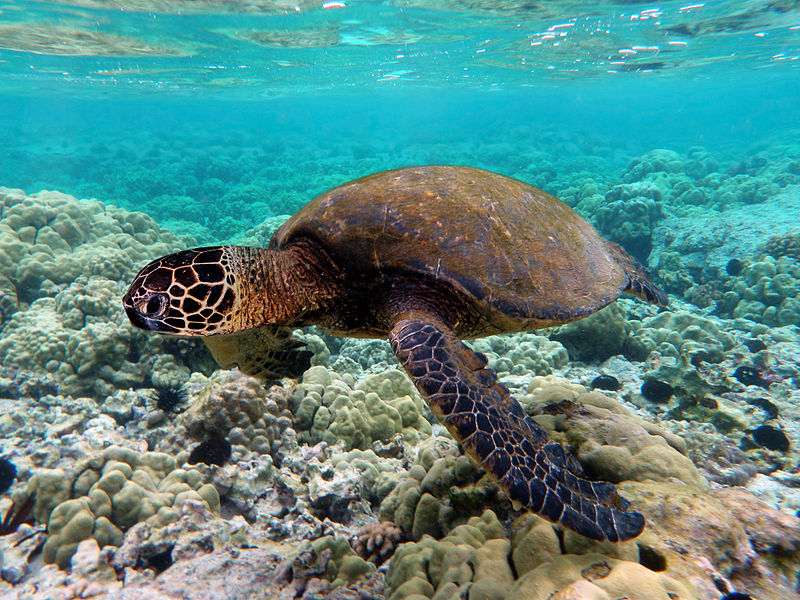
The Green sea turtle (Chelonia mydas), also known as the green turtle, black (sea) turtle, or Pacific green turtle, is a large sea turtle of the family Cheloniidae. This species is named for the green color of its fat, rather than the color of its skin of shell as most people think. These turtles shells are in fact olive to black. It is the only species in the genus Chelonia. Its range extends throughout tropical and subtropical seas around the world, with two distinct populations in the Atlantic and Pacific Oceans. The common name comes from the usually green fat found beneath its carapace.

This sea turtle's dorsoventrally flattened body is covered by a large, teardrop-shaped carapace; it has a pair of large, paddle-like flippers. It is usually lightly colored, although in the eastern Pacific populations parts of the carapace can be almost black. Unlike other members of its family, such as the hawksbill sea turtle, C. mydas is mostly herbivorous. The adults usually inhabit shallow lagoons, feeding mostly on various species of seagrasses. The turtles bite off the tips of the blades of seagrass, which keeps the grass healthy.

C. mydas is listed as endangered by the IUCN and CITES and is protected from exploitation in most countries. It is illegal to collect, harm or kill them. In addition, many countries have laws and ordinances to protect nesting areas. However, turtles are still in danger due to human activity. In some countries, turtles and their eggs are hunted for food. Pollution indirectly harms turtles at both population and individual scales. Many turtles die caught in fishing nets. Also, real estate development often causes habitat loss by eliminating nesting beaches.


Binomial Name:

Name : Chelonia mydas
Taxonomist : Carl Linnaeus (Småland - Sweden)
Year :
1758
Subspecies :
None, or no data available
Synonyms :
Many


Conservation Status by IUCN:

Status : Endangered

An Endangered (EN) species is a species which has been categorized by the International Union for Conservation of Nature (IUCN) Red List as likely to become extinct. "Endangered" is the second most severe conservation status for wild populations in the IUCN's schema after Critically Endangered (CR).

Many nations have laws that protect conservation-reliant species: for example, forbidding hunting, restricting land development or creating preserves. Population numbers, trends and species' conservation status can be found in the lists of organisms by population.

Philatelic Issues


2013 – Uruguay – Stamp 2 of 2, from Tourist Sites:Atlantic Coastline Series


Issue information:

Country: Uruguay
Date: December 4th, 2015
Printed: 15.000 Copies
Type: Stamp from Series of 2 Stamps
Value: UYP 15

Stamp: Rectangular
Size: 27 mm. x 39 mm.
Perforation: Circular
Gum: Water Activated

Monday, December 28, 2015

ANIMALS - REPTILES - SNAKES - BRAZILIAN GREEN RACER (PHILODRYAS AESTIVA)


Animals - Reptiles - Snakes

Brazilian Green Racer (Philodryas aestiva)


Scientific Classification:

Kingdom : Animalia
Phylum : Chordata
Subphylum : Vertebrata
Class : Reptilia
Order : Squamata
Suborder : Serpentes
Family : Colubridae
Subfamily : Xenodontinae
Genus : Philodryas
Species :
P. Aestiva


Description:

The Brazilian Green Racer (Philodryas aestiva) is a Snake in the genus Philodryas, so it shares the following characters:

Head distinct from neck, with distinct canthus rostralis. Eye moderate or large. Pupil round. Body cylindrical or slightly laterally compressed. Tail long.

Dorsal scales arranged in 17 to 23 rows at midbody, more or less obliquely. Subcaudals divided (in two rows).

Maxillary teeth smallest anteriorly, 12-15, followed after a gap by two large grooved fangs located just behind the posterior border of the eye.

Although colubrid snakes are usually harmless to humans, Philodryas are opisthoglyphous (rear-fanged) snakes and can give a venomous bite. However, they have mild venom; so a bite is unlikely to cause lasting damage to humans.


Binomial Name:

Name : Philodryas aestiva
Taxonomist : André Marie Constant Duméril (Amiens - France), Gabriel Bibron (Paris - France), Auguste Henri André Duméril (Paris - France)
Year :
1854
Subspecies :
2 (Aestiva, Subcarinata)
Synonyms :
Dryophylax aestivus, Philodryas aestivus, Tropidodryas aestivus, Philodryas campicola


Conservation Status by IUCN:

Status : Not Evaluated, or not data available


Philatelic Issues


2015 - Uruguay - Stamp 8 of 10, from Wetland Animals Series


Issue information:

Country: Uruguay
Date: June 5th, 2015
Printed: 10.000 Copies
Type: Stamp from Series of 10 Stamps
Value: UYP 15

Stamp: Rectangular
Size: 39 mm. x 27 mm.
Perforation: Circular
Gum: Water Activated

Donations

Imagine a world in which we all offered what we do best, and we all do what we like most to do.

Then, not only imagine it, but also live there. I'm already there, join us.

Hugs,
Diego

Share

In case you want to publish this article in another place, I will appreciate that you communicate with me first by adding a commentary in the article (click in "commentaries" underneath the the text). Commentaries are moderated so please do not hesitate to include your email address in them.

Hugs,
Diego