Showing posts with label Clothing. Show all posts

Wednesday, September 2, 2015

URU - 2015 - #026 - BRIEF DESCRIPTION - NATIONAL PAINTERS, FEDERICO SÁEZ AND ANHELO HERNÁNDEZ


Uruguay - 2015 - National Painters, Federico Sáez and Anhelo Hernández PreviousNext )


Options:

SERIES --- 2,00 EUR
STAMP 1 --- 1,50 EUR
STAMP 2 --- 1,50 EUR
SE-TENANT NORMAL --- 2,50 EUR
SE-TENANT INVERTED --- 3,00 EUR
SE-TENANT [2x2] --- 8,00 EUR
BLOCK --- 20,00 EUR
FDC not Sent --- 3,50 EUR

If you are interested in any of this items, or any other items from Uruguay, just make a donation including your e-mail in the description.

I will contact you as soon I receive your donation, we agree on which items do you need, and I will discount the donation done to the amount of your purchase.


Issue information:

Country: Uruguay
Date: August 27th, 2015
Printed: 15.000 copies

Stamp Shape and Size: Both Rectangular
[ Stamp 1: [25 mm. x 39 mm.]
Stamp 2: [23 mm. x 39 mm.] ]
Perforation: Circular
Gum: Water Activated

Block Configuration: 12 series [4 x 3] , 24 stamps [4 x 6]
[ [ Stamp 1, Stamp 2, Stamp 1, Stamp 2 Stamp 1, Stamp 2 ]
[ Stamp 1, Stamp 2, Stamp 1, Stamp 2 Stamp 1, Stamp 2 ]
[ Stamp 1, Stamp 2, Stamp 1, Stamp 2 Stamp 1, Stamp 2 ] ]
Block Shape and Size: Rectangular [202 mm. x 198 mm.]

FDC Type: Official Cover from Post Office
FDC Shape and Size: Rectangular [165 mm. x 105 mm.]


Catalogue information:

Michel: No Data Available
Ivert: No Data Available
Scott: No Data Available
Stanley & Gibbons: No Data Available

Topics:

Brief Description:

A brief description of the Most Popular Topics of this Release are: Painters, in particular the Uruguayan Painters, and among them, the ones selected this year for this annual issue of National Painters, that are: Federico Sáez and Anhelo Hernandez.  Also undoubtely Art Topic is included too, in particular Paintings and Uruguayan Paintings, and also Art Noveau, as both Artist could be included in that category.

Carlos Federico Sáez (14 November 1878, Mercedes - 4 January 1901, Montevideo) was an Artist from Uruguay. He was born into a wealthy family in the city of Mercedes in western Uruguay. By the age of 13 he was producing outstanding paintings and drawings. In 1891 he moved to Montevideo to study with the painter Juan Franzi. The well-known painter Juan Manuel Blanes recommended that Sáez go to study in Italy, which was a fairly common practice for wealthy young artists in Uruguay at that time. The national government provided him with an art scholarship at just 14 years of age. He spent the next seven years in Rome. He entered the Academy of Fine Arts in 1893, but was interested in new artistic movements such as the Macchiaioli and Art Nouveau. In 1896 he set up his own atelier in the Via Margutta, offering a number of shows. In 1900 he fell ill and returned to Montevideo where he died shortly after at the age of 22.

Sáez painted mainly Portraits. His work is characterised by Loose Brush Strokes that still convey a Realistic Precision. While he was in Italy he painted a number of portraits where the canvas is left visible - a technique used in Abstract Art, and which was not seen elsewhere until 1910. In his short career he produced more than 70 oil paintings and 100 drawings. He is considered one of the principal Uruguayan artists and the first to produce truly modern art.

Anhelo Hernández Ríos (Montevideo, Uruguay, 1922-2010) Artist, Researcher and Professor of Uruguay. He was born on November 21, 1922. Between 1935 and 1941, he studied sculpture and drawing with Alberto Savio, a disciple of Aristide Maillol. In 1941, he entered the School of Applied Arts and studied with Antonio Pena, Edmundo Pratto and F. Moller De Berg. In 1942 he became a student of the newly formed National School of Fine Arts and attended the workshop of the sculptor Severino Pose. In late 1942 he joined the workshop of Joaquín Torres García, of which it was part until the master's death in 1949. In 1969 he won on a competitive grant from the Union of Artists of Uruguay to study and work at the School of Art Berlin where his mentor was Professor Arno Mohr

Then, looking more at the desing of the Issue, each Stamp shows a Painting of each of the Artist, and the Topics that appears in each one are very different. In the first stamp, the Painting "El Chal Rojo", that in English means "The Red Shawl", shows a Portrait of a wealthy young lady wearing that Clothing Adornment, the Shawl, that give the name to the Painting.

The second Painting is called "Eros and Psique", in which, although the representation is quite Abstract, it main elements is a barely Nude Androgynous Couple Hugging and probably Kissing, surrounded by a kind of Constructions that reminds a Suburb.

Finally, a few more Topics could be add, as Paintbrush, and Palette, because of the icons that shows the ink colours used in the printing of the Block, and also Sun, Astronomy, Maps, and Maps of Uruguay as they appear in the FDC Cancelation.


If you consider that there are another topics in this stamp, that were not spot in this review, you are encouraged to telling me about them, so please do not hesitate to post a comment. I would appreciate your help very much.

Tuesday, August 19, 2014

URU - 2014 - #022 - DESCRIPTION - CENTENARY OF FOOTBALL CLUB "SUD AMÉRICA" (SPECIAL CANCELATION)


Uruguay - 2014 - Centenary of Football Club: "Sud América" PreviousNext )


Options:

FDC not Sent 1 --- 3,50 EUR
FDC not Sent 2 --- 3,50 EUR
FDC Sent on First Day 1 --- 7,00 EUR
FDC Sent on First Day 2 --- 7,00 EUR

If you are interested in any of this items, or any other items from Uruguay, just make a donation including your e-mail in the description.

I will contact you as soon I receive your donation, we agree on which items do you need, and I will discount the donation done to the amount of your purchase.


Issue information:

Country: Uruguay
Date: June 13th, 2014

FDC Type: Official Cover from Post Office
FDC not sent Shape and Size: Rectangular [165 mm. x 105 mm.]
FDC sent on issue day Shape and Size: Rectangular [165 mm. x 105 mm.]

Topics:

Issue:

As Main Topic: As it was with the Stamp issued with the same motif, I think Football or Soccer Topic will be the selected one, and this one in a wider Sports Topic. Then, going on the opposite direction, to more precise Topics: Uruguayan Football, Football Teams, Uruguayan Football Teams, even Centenarians Football Teams, and of course the team honoured itself "Institución Atlética Sud América" or "Sud América" too.

Then, surrounding the main topic, could be found the followings: First, the Centenary Topic, and then, going deeper, as the origins of the Club has his roots in the Jewish Neighbourhood, Jews could be a Topic related to this release. Then, the Club also has the particularity to be nicknamed "Buzones", that means Mailbox, so Mailbox itself and Post are Topics included in this Issue too.

Now, regarding the desing of the Special Cancelation: Besides reinforcing all the previously mentioned topics, it also add the Clothing Topic, or the more precise ones, Sportwears or T-Shirts, as the cancellation shows the sketch of a Football T-Shirt, that outline the text that commemorates the Centenary of Sud América Football Team.

Finally, in a more symbolic way: As well as in the Stamp of this motif, I said that the more symbolic Topics were by the side of The History of Uruguay, specially the Small Stories, the Anecdotes, the Simple Things, that step by step mades the History of any Nation, for the cancellation I think, by selecting the T-Shirt in the design, instead of the Neighbourhood and the Mailbox shown in the Stamp, the focus was shifted to Football itself rather than History.  


Stamps selection:

The stamps selected were: Naturally,the Stamp issued with the same motif was the first option, and one of the stamps selected, the other one was one Released on February 2nd of 2007 that commemorates the First Infantile Football World Cup, celebrated in Uruguay that year, and named "José Nazzasi", honouring this great Uruguayan Football Player.
 
The reason for selecting these stamps was: for the first one, trivial, because It match exactly with the Cancellation Topic, then the selection of the second one, although clearly influenced by Football Topic, none of the previous stamps were related with Sud América Team, so the stamp selected was one of many that could have worked well too.

The selection of this stamp in particular was due to it has the virtue of been rather Neutral insided the Football Topic, as although there were issued recently stamps about the Centenary of another Football Teams, I think that it would not be fair with the Football Team honoured in the Cancellation, using a stamp about another Club, so I prefered a Neutral one.

The other merit of the stamp selected, was his connection with the Past or History of Uruguayan Football, through the Personality of José Nazzasi.

The selection of this stamps, add the following topics: As already mentioned, both, the Cancellation and the first stamp selected, were released commemorating the same, so this stamps only reinforces the Topics that already exist in the Cancelation.

However, the second one, besides reinforcing Football or Soccer Topic, and this in a wider Sports, also includes some other more precise Topics inside Football, like Infantile Football, and more precise Infantile Football World Cups, and that in particular Infantile Football World Cup Uruguay 2007, probably all of them difficult to find in stamps, then there is another branch of Topics like Football Players or Uruguayan Football Players, and also the Personality of Jose Nazzasi too.

Then, following the path of José Nazzasi, several topics emerge. First Olympic Games, and Football World Cups, as he won both Olympic Game Paris 1924 and Olympic Game Amsterdam 1928, and also the World Cup Uruguay 1930, then other topics appears by the Football Teams in which he played, that were all Uruguayan Football TeamsCentro Atlético Lito, a team that now did not exist, and the still existing Club Atlético Bella Vista, and Club Nacional de Football.

Another Topic that could be seen in this second stamp is the Flags one, with the Flag of Uruguay in his design, and with the Flag of Uruguay, as already mentioned in previous issues, includes the presence of the Sun, more in particular the Sun of May that refers to the May Revolution, a week-long series of events that took place from May 18 to 25, 1810, in Buenos Aires, capital of the Viceroyalty of the Río de la Plata. This Spanish colony included roughly the territories of present-day Argentina, Bolivia, Paraguay and Uruguay. The result was the removal of Viceroy Baltasar Hidalgo de Cisneros and the establishment of a local government, the Primera Junta (First Junta), on May 25. It is also claimed that the Sun of May is a representation of the Inca Sun god Inti, and also another view is that is influenced by the emblem of the French Revolution, and that emblem was taken from the Freemasonic representations of the All-seeing eye.

Finally, some minor topics, like Balls, a new one in the Logotype, and an old one holded by José Nazzasi, are shown, and also the Tie and Suit Topics, that reinforces the wider Clothing Topic already present in the Cancellation, because of the strange way in which the kid is dressed.


If you consider that there are another topics in this stamp, that were not spot in this review, you are encouraged to telling me about them, so please do not hesitate to post a comment. I would appreciate your help very much.

URU - 2014 - #022 - FDC Sent on First Day 2 - CENTENARY OF FOOTBALL CLUB "SUD AMÉRICA" (SPECIAL CANCELATION)


Uruguay - 2014 - Centenary of Football Club: "Sud América"


If you are interested in any of this items, or any other items from Uruguay, just make a donation including your e-mail in the description.

I will contact you as soon I receive your donation, we agree on which items do you need, and I will discount the donation done to the amount of your purchase.


URU - 2014 - #022 - FDC Sent on First Day 1 - CENTENARY OF FOOTBALL CLUB "SUD AMÉRICA" (SPECIAL CANCELATION)


Uruguay - 2014 - Centenary of Football Club: "Sud América"


If you are interested in any of this items, or any other items from Uruguay, just make a donation including your e-mail in the description.

I will contact you as soon I receive your donation, we agree on which items do you need, and I will discount the donation done to the amount of your purchase.


URU - 2014 - #022 - FDC not Sent 2 - CENTENARY OF FOOTBALL CLUB "SUD AMÉRICA" (SPECIAL CANCELATION)


Uruguay - 2014 - Centenary of Football Club: "Sud América"


If you are interested in any of this items, or any other items from Uruguay, just make a donation including your e-mail in the description.

I will contact you as soon I receive your donation, we agree on which items do you need, and I will discount the donation done to the amount of your purchase.


URU - 2014 - #022 - FDC not Sent 1 - CENTENARY OF FOOTBALL CLUB "SUD AMÉRICA" (SPECIAL CANCELATION)


Uruguay - 2014 - Centenary of Football Club: "Sud América"


If you are interested in any of this items, or any other items from Uruguay, just make a donation including your e-mail in the description.

I will contact you as soon I receive your donation, we agree on which items do you need, and I will discount the donation done to the amount of your purchase.


URU - 2014 - #022 - DESCRIPTION - CENTENARY OF FOOTBALL CLUB "SUD AMÉRICA" (SPECIAL CANCELATION)


Uruguay - 2014 - Centenary of Football Club: "Sud América" PreviousNext )


Options:

FDC not Sent 1 --- 3,50 EUR
FDC not Sent 2 --- 3,50 EUR
FDC Sent on First Day 1 --- 7,00 EUR
FDC Sent on First Day 2 --- 7,00 EUR

If you are interested in any of this items, or any other items from Uruguay, just make a donation including your e-mail in the description.

I will contact you as soon I receive your donation, we agree on which items do you need, and I will discount the donation done to the amount of your purchase.


Issue information:

Country: Uruguay
Date: June 13th, 2014

FDC Type: Official Cover from Post Office
FDC not sent Shape and Size: Rectangular [165 mm. x 105 mm.]
FDC sent on issue day Shape and Size: Rectangular [165 mm. x 105 mm.]

Topics:

Issue:

As Main Topic: As it was with the Stamp issued with the same motif, I think Football or Soccer Topic will be the selected one, and this one in a wider Sports Topic. Then, going on the opposite direction, to more precise Topics: Uruguayan Football, Football Teams, Uruguayan Football Teams, even Centenarians Football Teams, and of course the team honoured itself "Institución Atlética Sud América" or "Sud América" too.

Then, surrounding the main topic, could be found the followings: First, the Centenary Topic, and then, going deeper, as the origins of the Club has his roots in the Jewish Neighbourhood, Jews could be a Topic related to this release. Then, the Club also has the particularity to be nicknamed "Buzones", that means Mailbox, so Mailbox itself and Post are Topics included in this Issue too.

Now, regarding the desing of the Special Cancelation: Besides reinforcing all the previously mentioned topics, it also add the Clothing Topic, or the more precise ones, Sportwears or T-Shirts, as the cancellation shows the sketch of a Football T-Shirt, that outline the text that commemorates the Centenary of Sud América Football Team.

Finally, in a more symbolic way: As well as in the Stamp of this motif, I said that the more symbolic Topics were by the side of The History of Uruguay, specially the Small Stories, the Anecdotes, the Simple Things, that step by step mades the History of any Nation, for the cancellation I think, by selecting the T-Shirt in the design, instead of the Neighbourhood and the Mailbox shown in the Stamp, the focus was shifted to Football itself rather than History.  


Stamps selection:

The stamps selected were: Naturally,the Stamp issued with the same motif was the first option, and one of the stamps selected, the other one was one Released on February 2nd of 2007 that commemorates the First Infantile Football World Cup, celebrated in Uruguay that year, and named "José Nazzasi", honouring this great Uruguayan Football Player.
 
The reason for selecting these stamps was: for the first one, trivial, because It match exactly with the Cancellation Topic, then the selection of the second one, although clearly influenced by Football Topic, none of the previous stamps were related with Sud América Team, so the stamp selected was one of many that could have worked well too.

The selection of this stamp in particular was due to it has the virtue of been rather Neutral insided the Football Topic, as although there were issued recently stamps about the Centenary of another Football Teams, I think that it would not be fair with the Football Team honoured in the Cancellation, using a stamp about another Club, so I prefered a Neutral one.

The other merit of the stamp selected, was his connection with the Past or History of Uruguayan Football, through the Personality of José Nazzasi.

The selection of this stamps, add the following topics: As already mentioned, both, the Cancellation and the first stamp selected, were released commemorating the same, so this stamps only reinforces the Topics that already exist in the Cancelation.

However, the second one, besides reinforcing Football or Soccer Topic, and this in a wider Sports, also includes some other more precise Topics inside Football, like Infantile Football, and more precise Infantile Football World Cups, and that in particular Infantile Football World Cup Uruguay 2007, probably all of them difficult to find in stamps, then there is another branch of Topics like Football Players or Uruguayan Football Players, and also the Personality of Jose Nazzasi too.

Then, following the path of José Nazzasi, several topics emerge. First Olympic Games, and Football World Cups, as he won both Olympic Game Paris 1924 and Olympic Game Amsterdam 1928, and also the World Cup Uruguay 1930, then other topics appears by the Football Teams in which he played, that were all Uruguayan Football TeamsCentro Atlético Lito, a team that now did not exist, and the still existing Club Atlético Bella Vista, and Club Nacional de Football.

Another Topic that could be seen in this second stamp is the Flags one, with the Flag of Uruguay in his design, and with the Flag of Uruguay, as already mentioned in previous issues, includes the presence of the Sun, more in particular the Sun of May that refers to the May Revolution, a week-long series of events that took place from May 18 to 25, 1810, in Buenos Aires, capital of the Viceroyalty of the Río de la Plata. This Spanish colony included roughly the territories of present-day Argentina, Bolivia, Paraguay and Uruguay. The result was the removal of Viceroy Baltasar Hidalgo de Cisneros and the establishment of a local government, the Primera Junta (First Junta), on May 25. It is also claimed that the Sun of May is a representation of the Inca Sun god Inti, and also another view is that is influenced by the emblem of the French Revolution, and that emblem was taken from the Freemasonic representations of the All-seeing eye.

Finally, some minor topics, like Balls, a new one in the Logotype, and an old one holded by José Nazzasi, are shown, and also the Tie and Suit Topics, that reinforces the wider Clothing Topic already present in the Cancellation, because of the strange way in which the kid is dressed.


If you consider that there are another topics in this stamp, that were not spot in this review, you are encouraged to telling me about them, so please do not hesitate to post a comment. I would appreciate your help very much.

Wednesday, April 17, 2013

URU - 2012 - #037 - SERIE - NEPTUNE CLUB CENTENARY


Uruguay - 2012 - Centenary of "Club Neptuno" (Neptune Club)


Options:

SERIE --- 1,40 EUR
SERIE [2X2] --- 5,50 EUR
FDC not Sent --- 2,80 EUR
FDC Sent on First Day --- 9,00 EUR
COVER Sent on First Day --- 6,00 EUR

If you are interested in any of this items, or any other items from Uruguay, just make a donation including your e-mail in the description.

I will contact you as soon I receive your donation, we agree on which items do you need, and I will discount the donation done to the amount of your purchase.


Issue information:

Country: Uruguay
Date: December 3rd, 2012
Printed: 15.000 copies

Stamp Shape and Size: Rectangular [27 mm. x 39 mm.]
Perforation: Circular
Gum: Water Activated

Block Configuration: 25 stamps [5 x 5]
Block Shape and Size: Rectangular [Unknown Size]

FDC Type: Normal
FDC Shape and Size: Rectangular [165 mm. x 105 mm.]
Cover Shape and Size: Rectangular [241 mm. x 159 mm.]

Catalogue information:

Michel: No Data Available
Ivert: No Data Available
Scott: No Data Available
Stanley & Gibbons: No Data Available

Topics:

Issue:

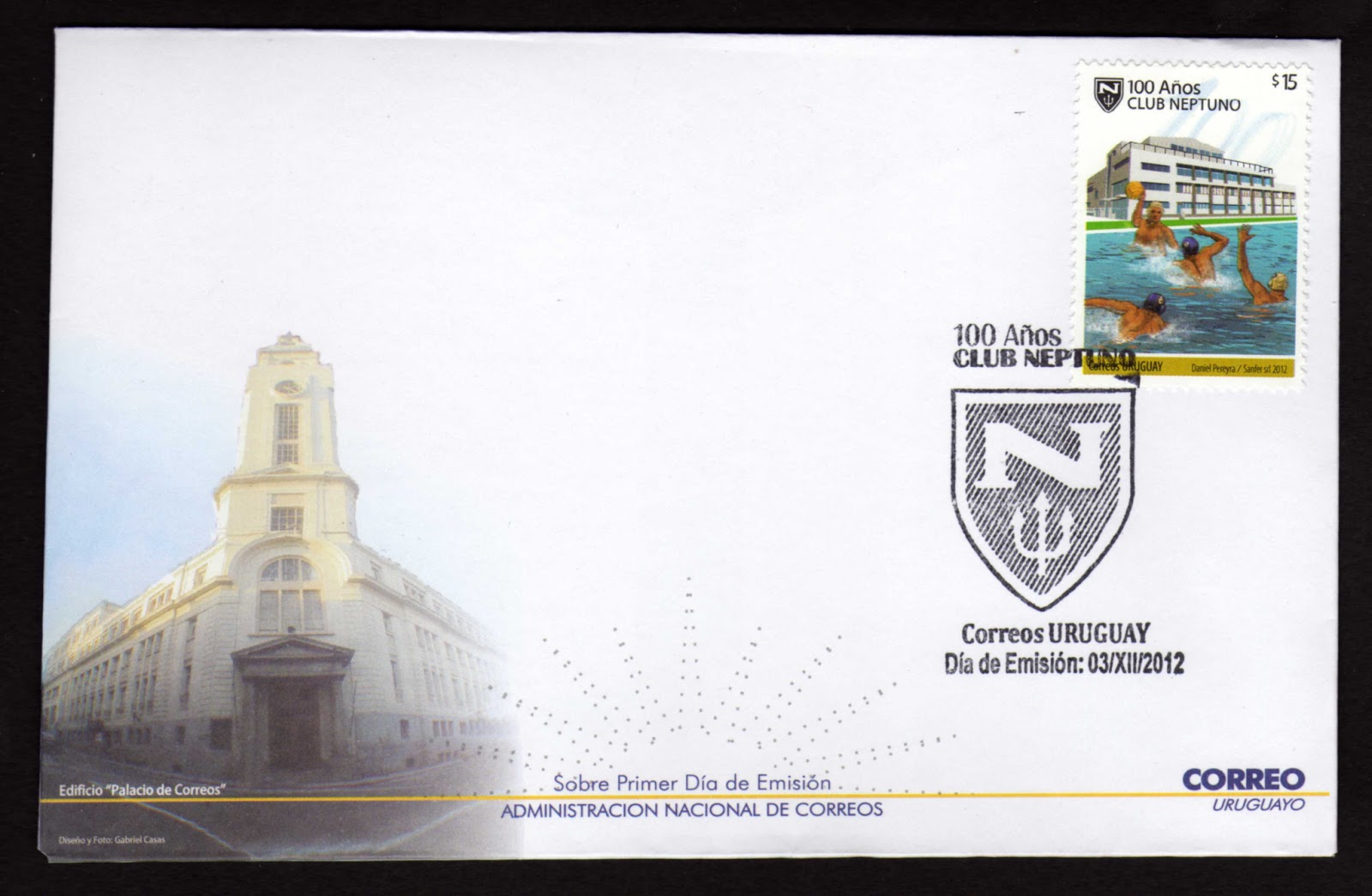
This stamp commemorates the Centenary of the "Club Neptuno", in english: "Neptune Club", a historical sport and social club of Montevideo, that was in its beginnings solely dedicated to water related sports, and that later extended its participation to other sports, having remarkable teams in basketball and volleyball.

The stamp was released just one day after the Centenary, as the club was founded on December 2nd, 1912, by Amador Franco, a swimming instructor that encouraged some amateur athletes to support him in the creation of this club, in a moment of a great boom of swimming sport.

The desing of the stamp depicts an action in a water polo match, with a background of the building of the club headquarter.

The club name honour the roman god of freshwater and the sea with the same name, and whose trident is the main object of the club coat of arms and logotype.

Neptune (Latin: Neptūnus) was the Roman god of freshwater and the sea in Roman religion. He is the counterpart of the Greek god Poseidon. In the Greek-influenced tradition, Neptune was the brother of Jupiter and Pluto, each of them presiding over the realms of Heaven, our earthly world and the Underworld, respectively.

Neptune was likely associated with fresh water springs before the sea. Like Poseidon, Neptune was worshipped by the Romans also as a god of horses, under the name Neptunus Equester, a patron of horse-racing.

Water polo, or Water ball, is a team water sport. The playing team consists of six field players and one goalkeeper. The winner of the game is the team that scores the most goals. Game play involves swimming, treading water (using a sort of kicking motion known as "eggbeater kick"), players passing the ball while being defended by opponents, and scoring by throwing the ball into a net defended by a goalie. 'Man-up' (or 'power play') situations occur frequently. Water polo, therefore, has strong similarities to the land-based game of team handball.

The history of water polo as a team sport began as a demonstration of strength and swimming skill in late 19th century England and Scotland, where water sports and racing exhibitions were a feature of county fairs and festivals. Men's water polo was among the first team sports introduced at the modern Olympic games in 1900. Water polo is now popular in many countries around the world, notably Europe (particularly in Serbia, Russia, Croatia, Italy, Montenegro, Greece and Hungary), the United States, Canada and Australia. The present-day game involves teams of seven players (plus up to six substitutes), with a water polo ball similar in size to a soccer ball but constructed of waterproof nylon.

One of the earliest recorded antecedents of the modern game of Water Polo was a game of water ‘hand-ball’ played at Bournemouth on 13 July 1876. This was a game between 12 members of the Premier Rowing Club, with goals being marked by four flags placed in the water near to the midpoint of Bournemouth Pier. The game started at 6.00pm in the evening and lasted for 15 minutes (when the ball burst) watched by a large crowd; with plans being made for play on a larger scale the following week.

The rules of water polo were originally developed in the late nineteenth century in Great Britain by William Wilson. Wilson is believed to have been the First Baths Master of the Arlington Baths Club in Glasgow. The first games of 'aquatic football' were played at the Arlington in the late 1800s (the Club was founded in 1870), with a ball constructed of India rubber. This "water rugby" came to be called "water polo" based on the English pronunciation of the Balti word for ball, pulu. Early play allowed brute strength, wrestling and holding opposing players underwater to recover the ball; the goalie stood outside the playing area and defended the goal by jumping in on any opponent attempting to score by placing the ball on the deck.

The desing of the stamp is completed with the legend: "100 Años Club Neptuno", that in english mean "100 Years of Neptune Club", also the logotype of the club with trident and the letter 'N', and a "100" as a vanished graffiti on the up part of the stamp.

Finally, the stamp could also be useful for a hats or clothing collection, because of the caps that water polo player usually wears and are shown in the stamp. And also, the trident in the club logotype, could make the stamp useful for weapon related collections.


FDC:

The Cancelation of the FDC it is a simple one, and besides the legend: "100 Años Club Neptuno", also includes the Club logotype with the trident and the big 'N' letter.


If you consider that there are another topics in this stamp, that were not spot in this review, you are encouraged to telling me about them, so please do not hesitate to post a comment. I would appreciate your help very much.

URU - 2012 - #037 - COVER Sent on First Day - NEPTUNE CLUB CENTENARY


Uruguay - 2012 - Centenary of "Club Neptuno" (Neptune Club)


If you are interested in any of this items, or any other items from Uruguay, just make a donation including your e-mail in the description.

I will contact you as soon I receive your donation, we agree on which items do you need, and I will discount the donation done to the amount of your purchase.


URU - 2012 - #037 - FDC Sent on First Day - NEPTUNE CLUB CENTENARY


Uruguay - 2012 - Centenary of "Club Neptuno" (Neptune Club)


If you are interested in any of this items, or any other items from Uruguay, just make a donation including your e-mail in the description.

I will contact you as soon I receive your donation, we agree on which items do you need, and I will discount the donation done to the amount of your purchase.


URU - 2012 - #037 - FDC not Sent - NEPTUNE CLUB CENTENARY


Uruguay - 2012 - Centenary of "Club Neptuno" (Neptune Club)


If you are interested in any of this items, or any other items from Uruguay, just make a donation including your e-mail in the description.

I will contact you as soon I receive your donation, we agree on which items do you need, and I will discount the donation done to the amount of your purchase.


URU - 2012 - #037 - SERIE [2X2] - NEPTUNE CLUB CENTENARY


Uruguay - 2012 - Centenary of "Club Neptuno" (Neptune Club)


If you are interested in any of this items, or any other items from Uruguay, just make a donation including your e-mail in the description.

I will contact you as soon I receive your donation, we agree on which items do you need, and I will discount the donation done to the amount of your purchase.


URU - 2012 - #037 - SERIE - NEPTUNE CLUB CENTENARY


Uruguay - 2012 - Centenary of "Club Neptuno" (Neptune Club)


Options:

SERIE --- 1,40 EUR
SERIE [2X2] --- 5,50 EUR
FDC not Sent --- 2,80 EUR
FDC Sent on First Day --- 9,00 EUR
COVER Sent on First Day --- 6,00 EUR

If you are interested in any of this items, or any other items from Uruguay, just make a donation including your e-mail in the description.

I will contact you as soon I receive your donation, we agree on which items do you need, and I will discount the donation done to the amount of your purchase.


Issue information:

Country: Uruguay
Date: December 3rd, 2012
Printed: 15.000 copies

Stamp Shape and Size: Rectangular [27 mm. x 39 mm.]
Perforation: Circular
Gum: Water Activated

Block Configuration: 25 stamps [5 x 5]
Block Shape and Size: Rectangular [Unknown Size]

FDC Type: Normal
FDC Shape and Size: Rectangular [165 mm. x 105 mm.]
Cover Shape and Size: Rectangular [241 mm. x 159 mm.]

Catalogue information:

Michel: No Data Available
Ivert: No Data Available
Scott: No Data Available
Stanley & Gibbons: No Data Available

Topics:

Issue:

This stamp commemorates the Centenary of the "Club Neptuno", in english: "Neptune Club", a historical sport and social club of Montevideo, that was in its beginnings solely dedicated to water related sports, and that later extended its participation to other sports, having remarkable teams in basketball and volleyball.

The stamp was released just one day after the Centenary, as the club was founded on December 2nd, 1912, by Amador Franco, a swimming instructor that encouraged some amateur athletes to support him in the creation of this club, in a moment of a great boom of swimming sport.

The desing of the stamp depicts an action in a water polo match, with a background of the building of the club headquarter.

The club name honour the roman god of freshwater and the sea with the same name, and whose trident is the main object of the club coat of arms and logotype.

Neptune (Latin: Neptūnus) was the Roman god of freshwater and the sea in Roman religion. He is the counterpart of the Greek god Poseidon. In the Greek-influenced tradition, Neptune was the brother of Jupiter and Pluto, each of them presiding over the realms of Heaven, our earthly world and the Underworld, respectively.

Neptune was likely associated with fresh water springs before the sea. Like Poseidon, Neptune was worshipped by the Romans also as a god of horses, under the name Neptunus Equester, a patron of horse-racing.

Water polo, or Water ball, is a team water sport. The playing team consists of six field players and one goalkeeper. The winner of the game is the team that scores the most goals. Game play involves swimming, treading water (using a sort of kicking motion known as "eggbeater kick"), players passing the ball while being defended by opponents, and scoring by throwing the ball into a net defended by a goalie. 'Man-up' (or 'power play') situations occur frequently. Water polo, therefore, has strong similarities to the land-based game of team handball.

The history of water polo as a team sport began as a demonstration of strength and swimming skill in late 19th century England and Scotland, where water sports and racing exhibitions were a feature of county fairs and festivals. Men's water polo was among the first team sports introduced at the modern Olympic games in 1900. Water polo is now popular in many countries around the world, notably Europe (particularly in Serbia, Russia, Croatia, Italy, Montenegro, Greece and Hungary), the United States, Canada and Australia. The present-day game involves teams of seven players (plus up to six substitutes), with a water polo ball similar in size to a soccer ball but constructed of waterproof nylon.

One of the earliest recorded antecedents of the modern game of Water Polo was a game of water ‘hand-ball’ played at Bournemouth on 13 July 1876. This was a game between 12 members of the Premier Rowing Club, with goals being marked by four flags placed in the water near to the midpoint of Bournemouth Pier. The game started at 6.00pm in the evening and lasted for 15 minutes (when the ball burst) watched by a large crowd; with plans being made for play on a larger scale the following week.

The rules of water polo were originally developed in the late nineteenth century in Great Britain by William Wilson. Wilson is believed to have been the First Baths Master of the Arlington Baths Club in Glasgow. The first games of 'aquatic football' were played at the Arlington in the late 1800s (the Club was founded in 1870), with a ball constructed of India rubber. This "water rugby" came to be called "water polo" based on the English pronunciation of the Balti word for ball, pulu. Early play allowed brute strength, wrestling and holding opposing players underwater to recover the ball; the goalie stood outside the playing area and defended the goal by jumping in on any opponent attempting to score by placing the ball on the deck.

The desing of the stamp is completed with the legend: "100 Años Club Neptuno", that in english mean "100 Years of Neptune Club", also the logotype of the club with trident and the letter 'N', and a "100" as a vanished graffiti on the up part of the stamp.

Finally, the stamp could also be useful for a hats or clothing collection, because of the caps that water polo player usually wears and are shown in the stamp. And also, the trident in the club logotype, could make the stamp useful for weapon related collections.


FDC:

The Cancelation of the FDC it is a simple one, and besides the legend: "100 Años Club Neptuno", also includes the Club logotype with the trident and the big 'N' letter.


If you consider that there are another topics in this stamp, that were not spot in this review, you are encouraged to telling me about them, so please do not hesitate to post a comment. I would appreciate your help very much.

Donations

Imagine a world in which we all offered what we do best, and we all do what we like most to do.

Then, not only imagine it, but also live there. I'm already there, join us.

Hugs,
Diego

Share

In case you want to publish this article in another place, I will appreciate that you communicate with me first by adding a commentary in the article (click in "commentaries" underneath the the text). Commentaries are moderated so please do not hesitate to include your email address in them.

Hugs,
Diego