Showing posts with label Procellariiformes. Show all posts

Saturday, March 5, 2016

ANIMALS – BIRDS – SEABIRDS – BLACK-BROWED ALBATROSS (THALASSARCHE MELANOPHRIS)


Animals - Birds - Seabirds

Black-browed Albatross (Thalassarche melanophris)


Scientific Classification:

Kingdom : Animalia
Phylum : Chordata
Class : Aves
Order : Procellariiformes
Family : Diomedeidae
Genus : Thalassarche
Species :
T. Melanophris


Description:


The Black-browed albatross (Thalassarche melanophris), also known as the Black-browed mollymawk, is a large seabird of the albatross family Diomedeidae; it is the most widespread and common member of its family.

Mollymawks are albatrosses in the family Diomedeidae and order Procellariiformes, which also includes shearwaters, fulmars, storm petrels, and diving petrels. These birds share certain identifying features. They have nasal passages that attach to the upper bill called naricorns, although the nostrils on the albatross are on the sides of the bill. The bills of Procellariiformes are also unique in that they are split into between seven and nine horny plates. They produce a stomach oil made up of wax esters and triglycerides that is stored in the proventriculus. This is used against predators as well as being an energy-rich food source for chicks and also for the adults during their long flights. The albatross also has a salt gland above the nasal passage which helps to remove salt from the ocean water that they imbibe. The gland excretes a high saline solution through the bird's nose.

The black-browed albatross was first described as Diomedea melanophris by Coenraad Jacob Temminck, in 1828, based on a specimen from the Cape of Good Hope.

The black-browed albatross is a medium-sized albatross, at 80 to 95 cm (31–37 in) long with a 200 to 240 cm (79–94 in) wingspan and an average weight of 2.9 to 4.7 kg (6.4–10.4 lb). It can have a natural lifespan of over 70 years. It has a dark grey saddle and upperwings that contrast with the white rump, and underparts. The underwing is predominantly white with broad, irregular, black margins. It has a dark eyebrow and a yellow-orange bill with a darker reddish-orange tip. Juveniles have dark horn-colored bills with dark tips, and a grey head and collar. They also have dark underwings. The features that distinguish it from other mollymawks (except the closely related Campbell albatross) are the dark eyestripe which gives it its name, a broad black edging to the white underside of its wings, white head and orange bill, tipped darker orange.


Binomial Name:

Name : Thalassarche melanophris
Taxonomist :
Coenraad Jacob Temminck (Amsterdam - Netherlands)
Year :
1828
Subspecies : 
None, or not data available
Synonyms :
Diomedea melanophris


Conservation Status by IUCN:

Status : Near-threatened species

A Near-threatened species is a species which has been categorized as "Near Threatened" (NT) by the International Union for Conservation of Nature as that may be considered threatened with extinction in the near future, although it does not currently qualify for the threatened status. The IUCN notes the importance of re-evaluating near-threatened taxa at appropriate intervals.


Philatelic Issues


2004 – Uruguay – Stamp 4 of 4, from Seabirds Series


Issue information:

Country: Uruguay
Date: January 22nd, 20
Printed: 15.000 copies
Type : Stamp from Series of 4 Stamps
Value :
UYP 14

Stamp : Rectangular
Size: 27 mm. x 39 mm.
Perforation: Circular
Gum: Water Activated

Friday, March 4, 2016

ANIMALS – BIRDS – SEABIRDS – CAPE PETREL (DAPTION CAPENSE)


Animals - Birds - Seabirds

Cape petrel (Daption capense)


Scientific Classification:

Kingdom : Animalia
Phylum : Chordata
Class : Aves
Order : Procellariiformes
Family : Procellariidae
Genus : Daption 
Species :
D. Capense


Description:

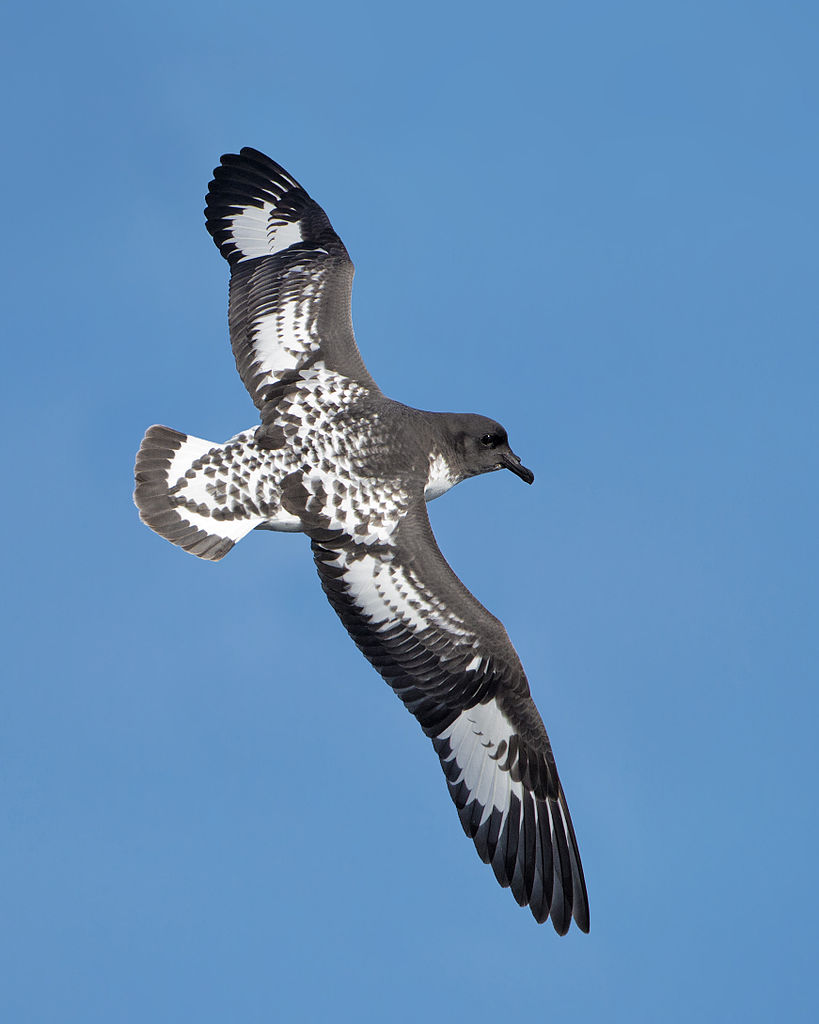
The Cape petrel (Daption capense), also called the Cape pigeon, Pintado petrel, or Cape fulmar, is a common seabird of the Southern Ocean from the family Procellariidae. It is the only member of the genus Daption, and is allied to the fulmarine petrels, and the giant petrels. They are extremely common seabirds with an estimated population of around 2 million.

The Cape petrel is the only known member of the genus Daption and is in turn a member of the family Procellariidae and order Procellariiformes. There appears to be a subgroup within the family consisting of the giant petrels, the members of Fulmarus, the Antarctic petrel, and the snow petrel.

All Procellariiformes share certain identifying features. First, they have nasal passages that attach to the upper bill called naricorns. The bills of Procellariiformes are also unique in that they are split into between seven and nine horny plates. They produce a stomach oil made up of wax esters and triglycerides that is stored in the proventriculus. This can be sprayed out of their mouths as a defence against predators and as an energy rich food source for chicks and for the adults during their long flights. Finally, they also have a salt gland that is situated above the nasal passage and helps desalinate their bodies, due to the high amount of ocean water that they imbibe. It excretes a high saline solution from their nose.

The Cape petrel is a unique looking petrel. It has a black head and neck, and a white belly, breast, and its underwing is white with a black border. Its back, and upperwings are black and white speckled, as is its tail which also has a band of black. When fully grown, their wings span 86 cm (34 in) and they are 39 cm (15 in) long.


Binomial Name:

Name : Daption capense
Taxonomist :
Carl Linnaeus (Småland - Sweden)
Year :
1758
Subspecies :
2 (Capense, Australe)
Synonyms : 
None, or not data available


Conservation Status by IUCN:

Status : Least Concern

Has been categorized by the International Union for Conservation of Nature as evaluated but not qualified for any other category. As such they do not qualify as threatened, near threatened, or (prior to 2001) conservation dependent.


Philatelic Issues


2004 – Uruguay – Stamp 3 of 4, from Seabirds Series


Issue information:

Country: Uruguay
Date: January 22nd, 20
Printed: 15.000 copies
Type : Stamp from Series of 4 Stamps
Value :
UYP 14

Stamp : Rectangular
Size: 27 mm. x 39 mm.
Perforation: Circular
Gum: Water Activated
Thursday, March 3, 2016

ANIMALS – BIRDS – SEABIRDS – NORTHERN GIANT PETREL (MACRONECTES HALLI)


Animals - Birds - Seabirds

Northern giant petrel (Macronectes halli)


Scientific Classification:

Kingdom : Animalia
Phylum : Chordata
Class : Aves
Order : Procellariiformes
Family : Procellariidae
Genus : Macronectes
Species :
M. Halli


Description:

The Northern giant petrel (Macronectes halli), also known as the Hall's giant petrel, is a large predatory seabird of the southern oceans. Its distribution overlaps broadly with the similar southern giant petrel, though it overall is centred slightly further north.

The northern giant petrel along with its counterpart, the southern giant petrel, make up the Macronectes genus. They come from the Procellariiformes order, which are referred to as tube-nosed seabirds, due to their unique nose structure. All tube-noses have tubular nostrils, and all Procellariidae have the openings on top of the upper portion of the bill. Procellariiformes also have between seven and nine distinct horny plates for their bill, and petrels have one of these plates that form the hooked portion of their upper bill called their maxillary unguis. They produce a stomach oil made up of wax esters and triglycerides that is stored in the proventriculus. This can be sprayed out of their mouths as a defence against predators as well as an energy rich food source for chicks and for the adults during their long flights. Finally, they also have a salt gland that is situated above the nasal passage and helps desalinate their bodies, due to the high amount of ocean water that they imbibe. It excretes a concentrated saline solution from their nostrils.

The northern giant petrel averages 90 cm (35 in) in length, with a range of 80 to 95 cm (31 to 37 in), possessing a wingspan of 150 to 210 cm (59 to 83 in). Size is somewhat variable and this species is broadly the same size as its southern sister species. The largest-bodied colony is in the South Georgia Islands, where 56 males averaged 4.9 kg (11 lb) and 43 females average 3.72 kg (8.2 lb). The smallest-bodied are on the Chatham Islands, where 19 males averaged 3.66 kg (8.1 lb) and 21 females averaged 2.83 kg (6.2 lb). Overall, weight for the species can range from 2.5 to 5.8 kg (5.5 to 12.8 lb). Its plumage consists of grey-brown body with lighter colored forehead, sides of face, and chin. Its bill is between 90 and 110 mm (3.5–4.3 in) long, being slightly longer on average than the southern giant petrel, and is pinkish yellow with a brown tip, and its eyes are grey.


Binomial Name:

Name : Macronectes halli
Taxonomist :
Gregory Mathews (Australia)
Year :
1912
Subspecies : 
None, or not data available
Synonyms :
None, or not data available

Conservation Status by IUCN:

Status : Least Concern

Has been categorized by the International Union for Conservation of Nature as evaluated but not qualified for any other category. As such they do not qualify as threatened, near threatened, or (prior to 2001) conservation dependent.


Philatelic Issues


2004 – Uruguay – Stamp 2 of 4, from Seabirds Series


Issue information:

Country: Uruguay
Date: January 22nd, 20
Printed: 15.000 copies
Type : Stamp from Series of 4 Stamps
Value :
UYP 14

Stamp : Rectangular
Size: 27 mm. x 39 mm.
Perforation: Circular
Gum: Water Activated

Tuesday, March 1, 2016

ANIMALS – BIRDS – SEABIRDS – GREAT SHEARWATER (ARDENNA GRAVIS)


Animals - Birds - Seabirds

Great shearwater (Ardenna gravis)


Scientific Classification:

Kingdom : Animalia
Phylum : Chordata
Class : Aves
Order : Procellariiformes
Family : Procellariidae
Genus : Ardenna
Species :
A. Gravis


Description:

The Great shearwater (Ardenna gravis; formerly Puffinus gravis) is a large shearwater in the seabird family Procellariidae. Its relationships are unclear. It belongs in the group of large species that have been separated as genus Ardenna (Penhallurick & Wink 2004); within these, it might be allied with the other black-billed, blunt-tailed species, the short-tailed shearwater and especially the sooty shearwater (Austin 1996, Heidrich et al. 1998). Alternatively (Austin 1996, Austin et al. 2004), it could be a monotypic subgenus (Ardenna sensu stricto), an Atlantic representative of the light-billed Hemipuffinus group (pink-footed shearwater and flesh-footed shearwater).

This species breeds on Nightingale Island, Inaccessible Island, Tristan da Cunha, and Gough Island. It is one of only a few bird species to migrate from breeding grounds in the Southern Hemisphere to the Northern Hemisphere, the normal pattern being the other way round. This shearwater nests in large colonies, laying one white egg in a small burrow or in the open grass. These nests are visited only at night to avoid predation by large gulls.

This shearwater is 43–51 cm in length with a 105–122 cm wingspan. It is identifiable by its size, dark upperparts, and underparts white except for a brown belly patch and dark shoulder markings. It has a black cap, black bill, and a white "horseshoe" on the base of the tail. The stiff flight, like a large Manx shearwater, is also distinctive. The only other large shearwater in its range is the all-dark sooty shearwater.


Binomial Name:

Name : Ardenna gravis
Taxonomist :
O'Reilly
Year :
1818
Subspecies : 
None or not data available
Synonyms :
Puffinus gravis, Procellaria gravis


Conservation Status by IUCN:

Status : Least Concern

Has been categorized by the International Union for Conservation of Nature as evaluated but not qualified for any other category. As such they do not qualify as threatened, near threatened, or (prior to 2001) conservation dependent.


Philatelic Issues


2004 – Uruguay – Stamp 1 of 4, from Seabirds Series


Issue information:

Country: Uruguay
Date: January 22nd, 20
Printed: 15.000 copies
Type : Stamp from Series of 4 Stamps
Value :
UYP 14

Stamp : Rectangular
Size: 27 mm. x 39 mm.
Perforation: Circular
Gum: Water Activated

Donations

Imagine a world in which we all offered what we do best, and we all do what we like most to do.

Then, not only imagine it, but also live there. I'm already there, join us.

Hugs,
Diego

Share

In case you want to publish this article in another place, I will appreciate that you communicate with me first by adding a commentary in the article (click in "commentaries" underneath the the text). Commentaries are moderated so please do not hesitate to include your email address in them.

Hugs,
Diego